KENHA reclaims road reserve in Githurai 45 to enhance safety and ease congestion.
The Kenya National Highways Authority (KeNHA) on Wednesday, February 18, 2026, carried out a major demolition exercise in Githurai 45, bringing down dozens of roadside structures erected along the busy highway corridor.
The early morning operation targeted stalls, kiosks, and semi-permanent structures that had encroached on the road reserve along the Thika Superhighway stretch. Bulldozers moved in under tight security, flattening iron-sheet shops and wooden sheds that traders had depended on for years.

According to KeNHA officials, the demolitions were part of an enforcement exercise to reclaim the road reserve and enhance safety along the highway. The authority maintained that the affected structures had been erected illegally within the designated road corridor, obstructing pedestrian movement and interfering with traffic flow.
Githurai 45, a densely populated commercial hub straddling Nairobi and Kiambu counties, experiences heavy traffic and human activity throughout the day. Informal traders line the highway selling food, clothes, electronics, and household goods to thousands of commuters. Over time, many of these businesses have expanded into spaces designated as road reserves.
Residents said the demolition began without much visible activity the night before. By sunrise on Wednesday, machinery was already on site. Traders scrambled to salvage goods as structures were pulled down. Some broke into tears as they watched years of investment reduced to rubble within minutes.
Tension continued to simmer overnight and spilled into full chaos on Thursday, February 19, 2026, as angry traders and residents staged protests. Demonstrators blocked sections of the highway in protest against the demolitions. They used stones, debris, and burning tyres to barricade parts of the road, bringing traffic to a standstill.
The protests caused major disruption along the busy Thika Superhighway corridor. Traffic snaked for kilometers, forcing motorists to seek alternative routes.
Public transport vehicles temporarily halted operations in some sections due to safety concerns.
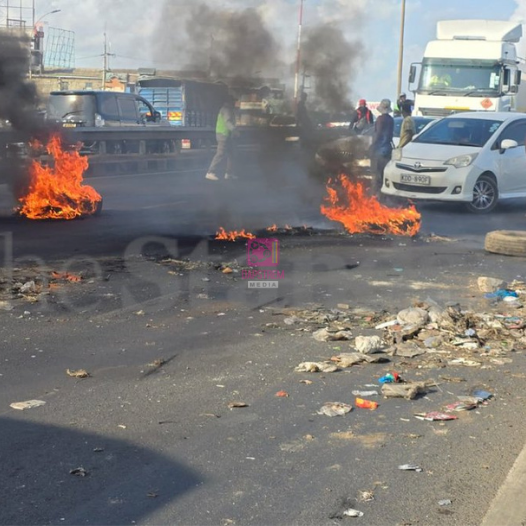
Police officers were deployed to disperse the protesters and restore order. Running battles were reported in parts of Githurai 45 as officers attempted to clear the barricades. Businesses in the area remained closed for hours as tensions remained high.
Traders accused the authorities of failing to provide adequate notice or alternative trading spaces. Many said their small stalls were their only source of income. For families already grappling with a tough economic climate, the demolitions dealt a heavy financial blow.
“We understand the road belongs to the government,” one trader said during the Thursday protests. “But they should have given us time or another place to operate.”
KeNHA defended the exercise, stating that reclaiming road reserves is essential for public safety and infrastructure protection. Officials noted that structures built too close to highways can obstruct visibility, endanger pedestrians, and hinder future road expansion or maintenance works.
The authority also pointed to persistent congestion in Githurai 45 as a reason for enforcement. The area has long struggled with uncontrolled roadside developments that squeeze pedestrian walkways and spill into traffic lanes.
Urban planning experts say the situation in Githurai reflects a broader national challenge. Rapid urban growth and limited formal employment have pushed many Kenyans into informal trade. Without sufficient designated markets, traders often occupy road reserves and public spaces.
While the demolitions may eventually improve traffic flow and restore order along the corridor, the social impact remains significant. Dozens of families now face uncertainty after losing their businesses.
By Thursday afternoon, calm had gradually returned after police cleared the barricades and traffic resumed. However, the economic and emotional scars of the two-day confrontation are likely to linger in Githurai 45.
The events of February 18 and 19, 2026, underscore the delicate balance between infrastructure enforcement and livelihoods. As authorities continue to reclaim public land, questions remain about how to protect vulnerable traders while maintaining order and safety on Kenya’s highways.