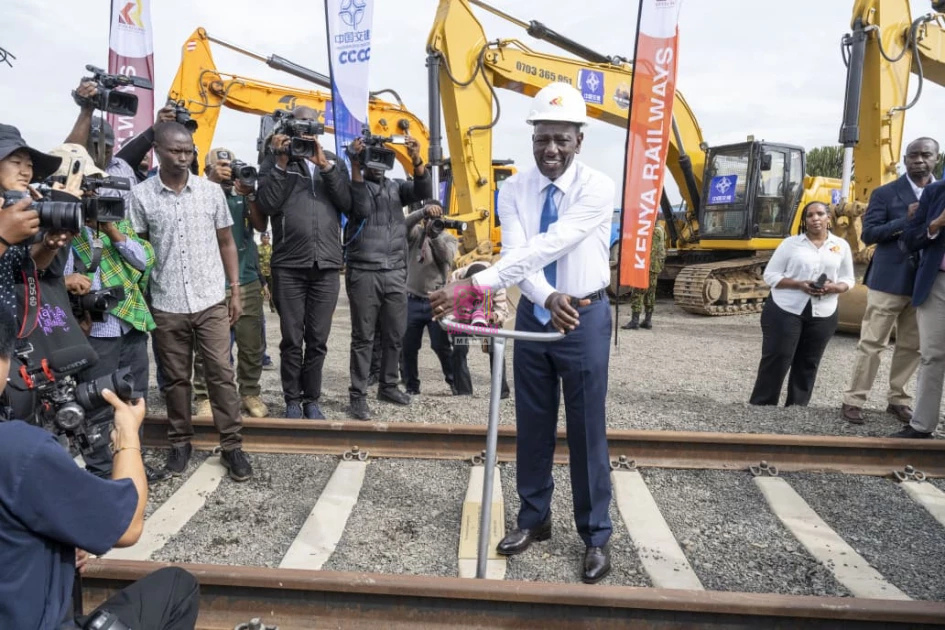
Kenya has officially restarted its multi-billion-shilling railway extension project after more than six years of delays caused by reduced Chinese funding. On Thursday, President William Ruto launched the project in Narok County, signaling renewed momentum for the country’s infrastructure development.
Previously, construction had stalled near Naivasha—over 350 kilometers short of the Ugandan border—after China scaled back financing for large African infrastructure projects under its Belt and Road Initiative. However, the government has now committed over Ksh. 500 billion to revive and complete the railway.
Project Structure and Key Sections
The project, which Kenya Railways is implementing in partnership with the National Land Commission, consists of two main sections: the Naivasha–Kisumu line and the Kisumu–Malaba line. Notably, the longer Naivasha–Kisumu stretch will cover 264 kilometers and receive the largest share of funding.
Timeline and Construction Plans
According to Kenya Railways Managing Director Philip Mainga, contractors will complete Phase 2B of the railway by June 2027. The Naivasha–Kisumu section will begin at Emurtoto in Narok County and extend to Kisumu, including an 8.69-kilometer branch line connecting to the proposed new Kisumu Port.
Along this route, engineers will construct six intermediate stations in Narok, Mulot, Bomet, Sotik, Sondu, and Ahero. In addition, the railway will pass through 17 crossing sections across Narok, Bomet, Nyamira, Kericho, and Kisumu counties.
Meanwhile, the 107-kilometer Kisumu–Malaba section will include intermediate stations in Yala and Mumias. It will also pass through six crossing stations—Kisian West, Ramala, Yala, Musanda, Manyulia, and Amukura—spanning Kisumu, Siaya, Vihiga, Kakamega, and Busia counties.
Engineering Design and Capacity
Furthermore, the project will feature 13 tunnels, 23 bridges, and 376 culverts, highlighting its scale and engineering complexity. Each passenger train will carry up to 1,096 passengers and operate at speeds of up to 120 km/h. At the same time, freight trains will transport up to 4,000 tonnes (216 TEUs) at speeds of 80 km/h, with an overall annual capacity of 22 million tonnes.
Importantly, the railway will use a uniform design specification to ensure seamless cross-border operations. As a result, the project is expected to significantly improve logistics efficiency both within Kenya and across neighboring countries.
In particular, the railway will reduce freight transport costs, accelerate the movement of goods and passengers, boost trade competitiveness, and strengthen regional connectivity and integration.
Earlier, Kenya completed the first section of the railway linking the port of Mombasa to Nairobi in 2017. However, critics have continued to question the project, arguing that it symbolizes China’s “debt trap diplomacy,” where Beijing provides large and often opaque loans to developing countries. Nevertheless, the Chinese government has consistently rejected these claims.