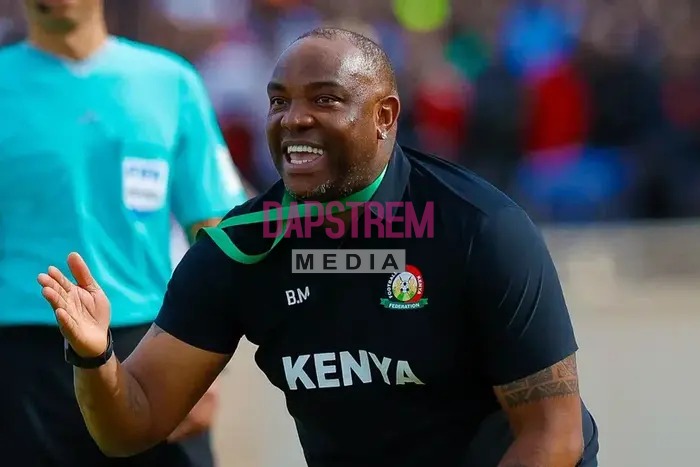
Even With Millions in Investment, McCarthy Warns Kenya Still Lacks the Quality and Depth to Win AFCON 2027
Kenya’s dream of winning the 2027 Africa Cup of Nations has suffered a major reality check after Harambee Stars head coach Benni McCarthy admitted that the team is currently not strong enough to compete for the continental title.
McCarthy, who took charge of the Kenyan national team in March 2025, has delivered one of his most honest assessments yet of the state of Kenyan football. The South African tactician believes that even being given millions of dollars would not suddenly transform Harambee Stars into an AFCON-winning side.
His comments come at a time when expectations around the national team are growing because Kenya will co-host the 2027 Africa Cup of Nations alongside Uganda and Tanzania.
For many Kenyan football fans, hosting AFCON is being viewed as a historic opportunity for Harambee Stars to announce themselves on the continental stage. The tournament will be played from June 19 to July 17, 2027, and Kenya is already guaranteed a place in the competition because of its status as a co-host.
But McCarthy is asking supporters to look beyond the excitement of hosting the tournament.
According to the former Manchester United coach, Kenya currently lacks the depth, player quality and football infrastructure required to compete with Africa’s strongest national teams.
His assessment comes after a difficult opening to Kenya’s AFCON 2027 qualifying campaign. Harambee Stars drew 1-1 with Eritrea in Nairobi before suffering a 1-0 defeat to Guinea in Conakry. Although Kenya does not need to qualify for the tournament because of its automatic qualification as a host, the matches are being used to prepare the team for the competition.

McCarthy’s message is therefore not necessarily that Kenya should abandon its AFCON ambitions. Instead, he appears to be warning that winning the tournament cannot be treated as an immediate target when the country is still trying to close a significant gap between itself and Africa’s established football powers.
In his assessment, teams such as Morocco, Senegal, Egypt, Côte d’Ivoire and South Africa possess a level of player quality and depth that Kenya currently cannot match.
“Even if you were to pay me millions and millions of dollars to win the AFCON, I don’t think Kenya has the resources and a team strong enough to compete with Morocco, Egypt, Ivory Coast, and Senegal,” McCarthy said, according to reports on his comments.
That statement has naturally attracted attention because Kenyan football supporters have become increasingly hopeful about the 2027 tournament.
The country has waited for years to see Harambee Stars compete at home against Africa’s best. The opportunity to host the continent’s biggest football tournament has created expectations that Kenya should not merely participate but should also challenge for the trophy.
McCarthy, however, believes there is a difference between participating in AFCON and being ready to win it.
Kenya will have the home advantage, passionate supporters and familiarity with the environment. Those factors can help a team perform above expectations. But they cannot automatically compensate for weaknesses in squad depth, experience and the number of players competing at the highest level.
This is where McCarthy believes the biggest challenge lies.
Kenya Has a Long Way to Go
Harambee Stars have talented players, including captain Michael Olunga, who remains one of the country’s most prominent footballers. McCarthy has also been introducing emerging players and giving opportunities to footballers based both in Kenya and abroad.
The coach’s latest AFCON squad included a mixture of established internationals and younger players as he attempts to build a team capable of competing at a higher level.
But one or two high-quality players are not enough to win a tournament as demanding as AFCON.
A team needs depth in almost every position.
It needs defenders who can deal with world-class forwards. It needs midfielders capable of controlling games against technically gifted opponents. It needs attackers who can punish even the smallest defensive mistake. It also needs substitutes who can enter a difficult match and change its direction.
McCarthy believes Kenya is not yet at that level.
The coach pointed to the number of Kenyan players competing in major European leagues compared with countries such as South Africa and Guinea.
The difference is significant.
Several of Africa’s leading national teams can select players from some of the world’s biggest leagues. Their squads often contain footballers competing in England, France, Spain, Italy, Germany and other highly competitive leagues.
That experience becomes particularly important during AFCON.
Players who regularly compete against elite opposition are more accustomed to pressure, high-intensity matches and tactical demands.
Kenya has fewer players operating at that level.
That does not mean Kenyan players lack talent. Rather, it highlights the gap in the football development system.
McCarthy therefore appears to be looking at the bigger picture rather than simply the results of individual matches.
If Kenya wants to win AFCON one day, the country must develop a football system capable of consistently producing players who can compete at the highest level.
Money alone cannot create that overnight.
The Recent Results Have Added to the Concern
The timing of McCarthy’s comments is important.
Harambee Stars recently began their AFCON 2027 qualifying campaign with a 1-1 draw against Eritrea at Nyayo National Stadium.
Ryan Ogam rescued Kenya with a late equaliser after Eritrea had taken the lead. The result left Kenya with one point from the opening match.
The team then travelled to Conakry to face Guinea.
Serhou Guirassy scored the only goal of the match as Guinea defeated Kenya 1-0. The result left Kenya with just one point after two matches.
While those results do not affect Kenya’s qualification for the finals, they provide McCarthy with valuable information about the team.
They show him where the weaknesses are.
They also give him competitive matches in which to test players, formations and tactics before the tournament arrives.
CAF has confirmed that Kenya, Tanzania and Uganda are automatically qualified as co-hosts. In Kenya’s Group D, South Africa, Guinea and Eritrea are effectively competing for the remaining qualification place.
For McCarthy, therefore, the qualifiers are effectively preparation matches with serious competitive value.
The results matter because they reveal how Kenya performs against teams that could resemble the level of opposition it will face at AFCON.
And so far, the evidence suggests that there is still considerable work to do.
McCarthy Is Not Giving Up on Kenya
Despite his blunt assessment, McCarthy is not saying Kenya cannot improve.
In fact, his broader message has been about development.
The South African coach has previously spoken about needing more time with his players and using competitive matches to improve the team before AFCON 2027.
That distinction is important.
Saying Kenya is unlikely to win AFCON today is not the same as saying Kenya cannot become a stronger team before the tournament.
There is still significant time before the competition begins.
The tournament will only start in June 2027.
Between now and then, McCarthy can continue experimenting with the squad, identifying new players and improving tactical organisation.
Kenyan players can also continue developing at club level.
If more Kenyan footballers move to stronger leagues and receive regular playing time against quality opposition, the national team’s level could improve.
That is ultimately the long-term solution McCarthy appears to be advocating.
The coach has already shown a willingness to bring new faces into the national team. His squad selection for the opening AFCON qualifiers included both established players and emerging talents from Kenya and abroad.
The challenge now is turning that talent into a balanced and competitive squad.
Millions of Dollars Cannot Buy Football Development Overnight
McCarthy’s reference to millions of dollars is particularly interesting because it touches on one of the biggest debates surrounding Kenyan football.
There is often an assumption that more money automatically means better football.
Money certainly matters.
A well-funded national team can provide better training camps, quality equipment, international friendly matches, professional technical staff, player welfare and improved travel arrangements.
But money cannot instantly produce world-class players.
It cannot manufacture experience.
It cannot make a young defender suddenly understand how to deal with a world-class striker.
It cannot give a midfielder years of experience playing in Europe’s top competitions.
And it cannot replace a strong football development structure.
This is why McCarthy’s comments should perhaps be understood as a call for patience rather than simply a pessimistic prediction.
Kenya needs investment, but it needs smart and sustained investment.
The country needs stronger youth development programmes.
It needs competitive grassroots football.
It needs better coaching structures.
It needs clubs capable of developing players and giving young footballers regular opportunities.
It needs more Kenyan players competing at higher levels outside the country.
It also needs national-team preparation to be professional and consistent.
Recent problems surrounding Harambee Stars’ preparations have shown that even basic issues can affect the team’s concentration.
In September, McCarthy raised concerns over unpaid allowances, work permit problems and player welfare ahead of the AFCON qualifier against Eritrea. Players had reportedly refused to train amid concerns over outstanding payments.
The Sports Ministry subsequently said previous financial commitments relating to Harambee Stars had been settled, while other payments were undergoing administrative processing.
These issues may appear unrelated to the technical quality of the team, but they are part of the larger football environment.
A national team cannot be expected to perform at its best when preparations are repeatedly disrupted by administrative problems.
Home Advantage Could Still Change the Story
Despite McCarthy’s warning, Kenya will have one major advantage in 2027.
The country will be playing on home soil.
Home support can be powerful.
Thousands of Kenyan fans are expected to fill stadiums, creating an atmosphere that opponents will have to deal with.
The players will also have familiar surroundings and supporters behind them.
For a team that may not possess the same individual quality as Morocco, Senegal or Egypt, home advantage could help close the gap.
Football has repeatedly demonstrated that tournaments can produce unexpected results.
Strong teams can struggle.
Underdogs can surprise favourites.
A well-organised team can defeat an opponent with better individual players.
Kenya therefore should not enter AFCON already believing that victory is impossible.
At the same time, unrealistic expectations could create unnecessary pressure.
If fans expect Harambee Stars to win the tournament simply because Kenya is hosting it, disappointment could become intense after the first difficult result.
A more realistic objective could be to build a team capable of competing strongly in the group stage, reaching the knockout rounds and then seeing how far the journey can go.
If Kenya reaches the knockout stages, it would already represent a significant step forward.
From there, anything can happen.
The Bigger Question Is What Happens After 2027
Perhaps the most important part of McCarthy’s argument is not about AFCON 2027.
It is about what Kenyan football wants to become after the tournament.
AFCON 2027 provides Kenya with an opportunity to build something that lasts beyond the competition.
CAF describes the tournament as a historic edition because Kenya, Uganda and Tanzania will become the first three countries to jointly host AFCON. The tournament is also returning to East Africa for the first time in more than five decades.
That creates an opportunity for Kenya to strengthen its football infrastructure.
The country can use the tournament to improve stadiums, training facilities, youth academies, coaching programmes and football administration.
It can also use the exposure to inspire young players.
A Kenyan child watching AFCON matches in Nairobi may decide that football is something they can pursue professionally.
That inspiration can become part of the tournament’s most important legacy.
But it will only happen if the country continues investing after the final whistle.
If the focus is only on the 2027 tournament, Kenya could miss the bigger opportunity.
The ultimate goal should be to create a football system that produces competitive national teams year after year.
Then winning AFCON would no longer look like an unrealistic dream.
It would become the result of sustained development.
McCarthy Has Put the Pressure Back on the Football System
The coach’s comments have also shifted the conversation.
Instead of simply asking whether Benni McCarthy can win AFCON with Harambee Stars, Kenyan football stakeholders now have to ask whether the system is producing a team capable of winning AFCON.
That is a much bigger question.
A coach can select the best available players.
He can organise training sessions.
He can develop tactics.
He can motivate the team.
But he cannot control the entire football development structure.
He cannot create a generation of elite players within a few months.
He cannot change the quality of the domestic league overnight.
And he cannot force more Kenyan players into Europe’s biggest competitions.
Those are long-term responsibilities involving FKF, clubs, academies, schools, government and other football stakeholders.
McCarthy can only work with what he has.
His job now is to make the best possible team from the players available to him.
And there is still time to make improvements.
Kenyan Fans Should Dream, But They Should Also Be Patient
Football is ultimately built on belief.
Kenyan fans should dream about AFCON glory.
There is nothing wrong with believing that Harambee Stars can shock Africa in 2027.
But that belief must be balanced with an understanding of where the team currently stands.
McCarthy has offered a brutally honest assessment because he sees the challenge from inside the team.
He knows the quality of players available to Kenya.
He has also worked in environments where footballers compete at the highest level.
His experience gives weight to his warning.
At the same time, football is unpredictable.
The gap between Kenya and Africa’s strongest teams can be reduced.
The squad can improve.
Young players can emerge.
Established players can develop.
New talent can be discovered.
And the home crowd can make a difference.
The objective should therefore not be to surrender before the tournament begins.
Instead, Kenya should use the remaining months to build the strongest possible team.
Every international match should have a purpose.
Every training camp should contribute to the team’s development.
Every young player with potential should be properly monitored.
Every administrative problem should be addressed before it becomes a distraction.
And every opportunity to expose Kenyan players to high-level football should be taken seriously.
McCarthy may not believe Harambee Stars can win AFCON today.
But that does not mean Kenya cannot become a better team by the time the tournament arrives.
For now, his message is clear: money alone will not make Kenya African champions.
The country needs players, structure, experience, development and patience.
AFCON 2027 will give Harambee Stars the biggest stage they have had in years.
Whether Kenya uses that stage merely to participate or to begin building a genuinely competitive football nation will depend on what happens between now and the tournament.
McCarthy may be warning Kenyans not to expect miracles.
But perhaps that warning is exactly what Kenyan football needs.
Instead of searching for a quick path to AFCON glory, the country must build a foundation strong enough to make continental success possible.
The trophy may not come in 2027.
But if the right lessons are learned, the journey towards eventually winning it can begin now.