Kenya Intensifies Ebola Response as 57 Contacts Are Traced and 10 Placed Under Quarantine
Kenya has intensified its response to Ebola after health authorities identified 57 people who may have come into contact with the country’s first confirmed Ebola patient.
Ten of the identified contacts have so far been placed under quarantine as the Ministry of Health works to trace the remaining people who may have been exposed.
The development comes days after Kenya confirmed its first imported case of Bundibugyo Ebola Virus Disease involving a Kenyan citizen who had been living in the Democratic Republic of Congo.
The patient later died while receiving treatment in Nairobi, prompting an urgent contact-tracing operation involving family members, health workers, airline passengers, crew members and other people who may have interacted with him.
Health authorities have stressed that Kenya is not currently experiencing an Ebola outbreak. The confirmed infection has been classified as an imported case linked to the ongoing Ebola situation in the Democratic Republic of Congo.
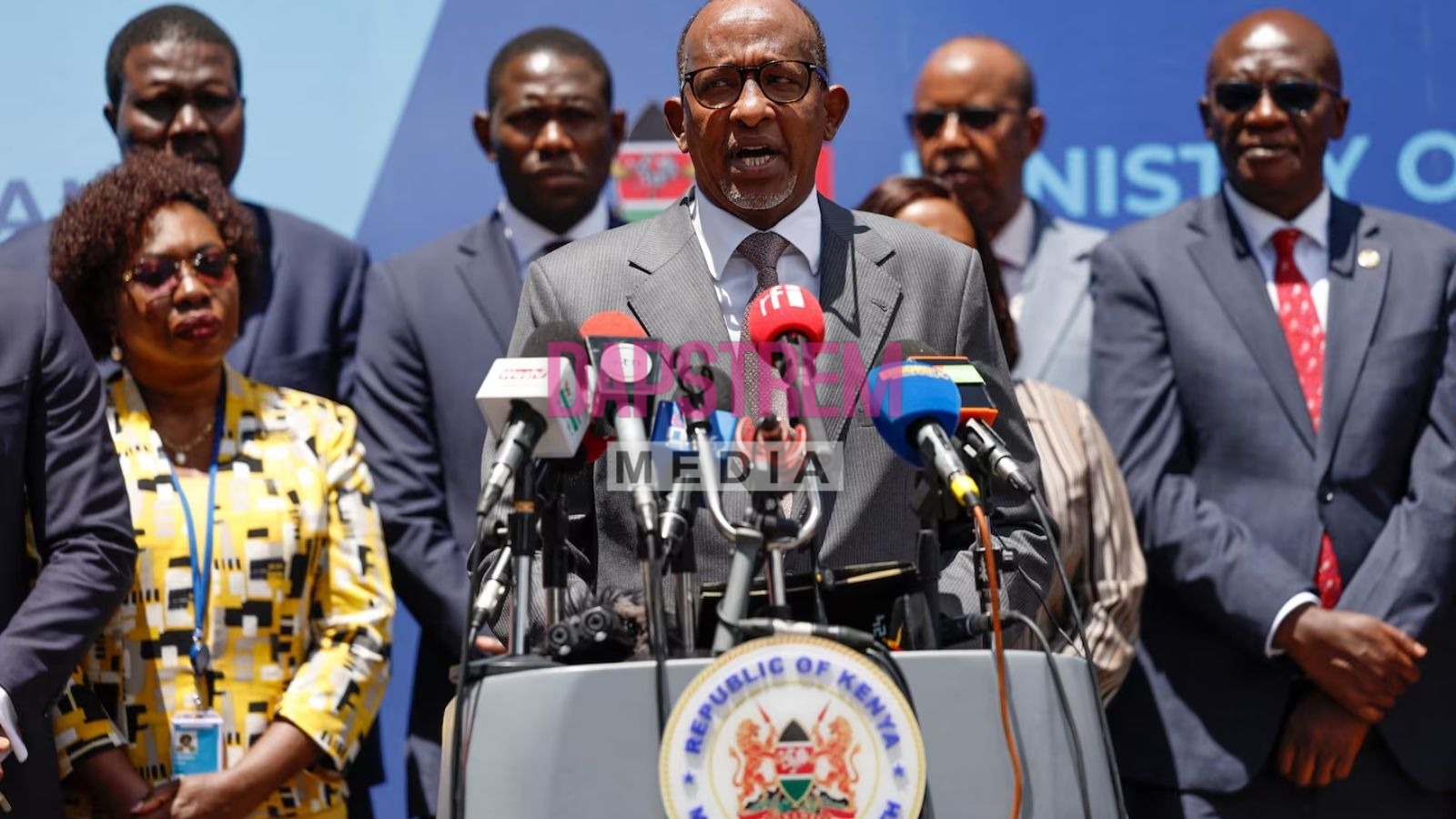
Health Cabinet Secretary Aden Duale has urged Kenyans to remain calm while following the precautionary measures issued by the government.
The increase in the number of contacts being followed is, however, a significant development because contact tracing is one of the most important tools available to health authorities when dealing with Ebola.
Officials must identify people who may have been exposed, monitor them for symptoms and quickly isolate anyone who develops signs of infection.
The Ministry says contact tracing remains active and that the number could increase as investigators continue reconstructing the patient’s movements before he was admitted to hospital.
How the patient arrived in Kenya
The confirmed case involved a Kenyan citizen who had been living in the Democratic Republic of Congo.
According to the Ministry of Health, the patient had fallen ill about a month before arriving in Kenya and had received treatment at several health facilities in the DRC.
He later travelled by road from the DRC to Kampala, Uganda, before boarding Jambojet flight 8523 to Nairobi.
The flight arrived at Jomo Kenyatta International Airport at approximately 1:10 p.m. on Saturday, October 3.
Upon arrival, the patient passed through the normal port health and immigration processes.
He was not identified as an Ebola case at the airport.
After leaving the airport, he was taken directly to Nairobi Hospital by a relative and a friend.
His condition, however, raised concern among medical workers.
The patient presented with symptoms including fever, chills, intense fatigue, weakness, muscle pain, painful swallowing, a sore throat and bleeding under the skin at injection sites.
The bleeding was particularly important because it raised suspicion of a viral haemorrhagic fever.
Doctors subsequently collected a sample for laboratory testing.
The National Virology Reference Laboratory and the Kenya Medical Research Institute independently confirmed that the patient had Bundibugyo Ebola Virus Disease.
The patient was immediately managed under isolation and infection-prevention measures at The Nairobi Hospital.
He was transferred to the hospital’s East Wing Isolation Facility, where he received supportive treatment.
Despite the efforts of medical teams, his condition deteriorated and he died on October 5.
His death triggered the country’s first major Ebola contact-tracing operation.
Contact tracing becomes the centre of Kenya’s response
The Ministry initially identified contacts connected to the patient, including family members and health workers who had attended to him.
Authorities also began tracing passengers and crew members who travelled on the same flight from Entebbe to Nairobi.
The initial figures have since increased.
Health authorities now say 57 contacts have been identified, with 10 already placed under quarantine.
The 10 people in quarantine are being monitored for symptoms as officials continue following up on the remaining contacts.
The National Police Service Hospital in Nairobi is among the facilities being used for quarantine.
Officials are also working to establish exactly where the patient travelled, who he interacted with and how long he remained in contact with different people before his condition was confirmed.
The investigation is not limited to the hospital.
It extends to the airport, the flight, the patient’s family and the people who helped him travel from the airport to hospital.
At Jomo Kenyatta International Airport, authorities have listed staff members who were on duty and may have interacted with the patient when he arrived on October 3.
The Ministry is also tracing passengers and crew members from the flight.
This is important because the patient travelled before his infection was confirmed.
Some people who were around him during that period may not have known that they had potentially been exposed.
Contact tracing therefore gives health officials an opportunity to find them before they develop symptoms or potentially expose other people.
Health officials have said the patient’s family has been cooperative throughout the investigation.
Duale said the family provided information about the patient’s movements and contacts, including where he had been staying and the people he had interacted with.
Such cooperation is critical during an outbreak response because health authorities rely heavily on accurate information to reconstruct a patient’s movements.
The Ministry has said the information provided by the family has helped investigators identify additional contacts.
Kenya strengthens surveillance and treatment capacity
The confirmation of the imported case has also prompted Kenya to strengthen surveillance at points of entry.
The government has increased screening and monitoring of travellers arriving from countries affected by Ebola transmission.
At JKIA, passengers from several countries in the region are being directed through a designated screening point as health authorities seek to improve surveillance.
The Ministry has also heightened surveillance at multiple points of entry across the country.
This includes border areas where travellers frequently cross between Kenya and neighbouring countries.
The government has also been preparing health facilities to handle suspected or confirmed Ebola cases.
Five facilities have been designated to manage Ebola cases, including Kenyatta National Hospital, Moi Teaching and Referral Hospital, National Police Hospital, Port Reitz Hospital and The Nairobi Hospital.
Additional temporary isolation facilities have also been identified in border areas.
The preparations are intended to ensure that suspected patients can be separated from the general population while tests are conducted.
Health workers have also received specialised training.
The Ministry said 4,971 health workers at national and sub-national levels had received training in Ebola prevention and management before the latest case was confirmed.
Kenya had also screened more than 652,000 travellers and tested hundreds of samples in different laboratories as part of its preparedness efforts.
Only one sample had tested positive before the patient died.
These preparations are now being put to the test.
Why contact tracing matters
Ebola is a serious viral disease that can spread through direct contact with the blood or bodily fluids of an infected person.
This makes early identification and monitoring of contacts extremely important.
Unlike diseases that can spread easily through the air over long distances, Ebola transmission is strongly associated with direct exposure to infected bodily fluids.
That means identifying people who may have had close contact with an infected patient can significantly reduce the risk of further transmission.
The current situation therefore does not mean that everyone who travelled on the same aircraft or visited the same facility will develop Ebola.
Instead, health officials are monitoring those considered to have had a potential exposure.
People placed under quarantine are being monitored so that if symptoms develop, they can receive immediate medical attention and be isolated.
This approach is designed to break possible chains of transmission before they grow.
The government is therefore relying on three major measures: contact tracing, quarantine and surveillance.
The success of the response will depend heavily on how quickly authorities can identify the remaining contacts.
It will also depend on whether those being monitored follow health guidance and report any symptoms immediately.
Government urges Kenyans not to panic
Despite the seriousness of the confirmed case, health officials have repeatedly urged Kenyans not to panic.
Public Health and Professional Standards Principal Secretary Mary Muthoni said the country remains alert and that health officers across the country have been activated to respond to suspected cases.
She also said the Ministry is working with county governments and faith-based health facilities to prepare for any possible increase in suspected cases.
Health Cabinet Secretary Aden Duale has similarly maintained that Kenya has systems in place to respond to the threat.
The government has urged members of the public to rely on official information rather than rumours circulating on social media.
Kenyans have also been advised to practise regular handwashing or use alcohol-based hand sanitiser.
People have been encouraged to avoid close contact with individuals who are sick and to seek medical attention at recognised health facilities if they develop concerning symptoms.
Health workers have been told to maintain strict infection-prevention and control measures.
The Ministry has also provided the toll-free 719 health information line for members of the public seeking official information about the situation.
First Ebola burial conducted under strict protocols
Following the patient’s death, the Ministry of Health worked with the Kenya Red Cross Society to conduct a safe and dignified burial.
The patient was buried at Lang’ata Cemetery on Wednesday under strict public health protocols designed to minimise the risk of transmission.
Safe burial is an important part of Ebola control because the bodies of people who die from the disease can remain highly infectious.
Special precautions are therefore required during handling, transportation and burial.
The burial was conducted while authorities continued their efforts to trace people who may have been exposed before the patient was diagnosed.
The development marked a sombre moment for Kenya, which had previously managed to avoid recording a confirmed Ebola infection despite the country’s proximity to regions that have experienced outbreaks.
Kenya’s biggest challenge is now preventing a second case
The immediate priority for health authorities is no longer simply identifying the first patient.
The focus has shifted towards ensuring that the infection does not lead to secondary transmission.
That will depend largely on the effectiveness of contact tracing.
Every person identified as a contact must be located, assessed and monitored.
Those considered at higher risk must remain under quarantine for the required monitoring period.
If anyone develops symptoms, health workers must act quickly to isolate and test them.
The Ministry is also expected to continue working with authorities in Uganda and the Democratic Republic of Congo to reconstruct the patient’s journey.
That cross-border cooperation is important because the patient’s movements involved multiple countries.
The case has also raised questions about how the patient managed to travel through several points of entry before his illness was identified.
Kenya had already maintained heightened Ebola surveillance since the outbreak in the DRC began in May.
The latest case has therefore provided an important test of those systems.
Health authorities say the rapid response at Nairobi Hospital helped prevent wider exposure.
The hospital had the necessary protective equipment and moved the patient into isolation after Ebola became a concern.
The medical team’s decision to suspect a viral haemorrhagic fever after noticing bleeding at an injection site was also critical.
The laboratory turnaround time further helped authorities confirm the diagnosis and begin contact tracing.
These factors could prove important in determining whether Kenya manages to contain the imported infection.
For now, the country remains in a heightened state of alert.
The identification of 57 contacts does not mean that Kenya has 57 Ebola cases.
It means that health authorities have identified people who may have had contact with the confirmed patient and therefore need monitoring.
Only the original patient has been confirmed as infected in Kenya so far, according to the Ministry of Health.
The 10 people in quarantine are being monitored as a precaution while officials continue tracing the remaining contacts.
The coming days will be crucial.
If the remaining contacts are successfully located and no secondary infections emerge, Kenya could contain the imported case without a wider outbreak.
But health officials will need to remain vigilant because the situation can change quickly.
For ordinary Kenyans, the message from the Ministry remains straightforward: stay informed, maintain good hygiene, avoid unnecessary close contact with sick people and seek medical care if symptoms develop.
Most importantly, members of the public should avoid spreading unverified information.
The government’s ability to contain Ebola will depend not only on hospitals, laboratories and health workers but also on cooperation from communities.
As contact tracing continues, Kenya is effectively racing against time to ensure that its first confirmed Ebola case remains an isolated incident rather than the beginning of a wider public health crisis.