
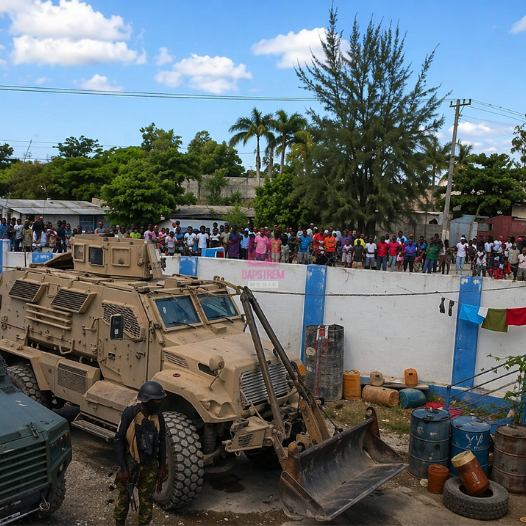
Haitian residents erect barricades and protest the exit of Kenyan police, warning that their departure could leave communities vulnerable to a resurgence of gang violence and insecurity
The unfolding situation in Haiti has taken a dramatic turn as civilians move to block the withdrawal of Kenya Police Service officers, exposing deep fears about what lies ahead once the foreign security mission comes to an end. What was initially meant to be a transition phase has instead become a tense standoff between residents desperate for protection and a mission preparing to exit after nearly two years on the ground.
The scenes emerging from towns such as Petite Rivière and Pont-Sondé paint a picture of a population caught between relief and anxiety. In recent days, hundreds of civilians have taken to the streets, erecting barricades and physically blocking roads to prevent Kenyan officers from leaving. Some even attempted to interfere with evacuation efforts, including helicopter departures, highlighting just how critical the presence of the officers has become to sections of the Haitian population.
These protests are rooted in a simple but powerful fear: that once the Kenyan-led force leaves, gangs will quickly reclaim control, plunging communities back into chaos. Haiti has for years struggled with powerful armed groups that control large parts of the capital, Port-au-Prince, and surrounding regions. For many residents, the presence of foreign security forces—particularly the Kenyan contingent—offered a rare sense of stability.
Kenya’s involvement in Haiti dates back to June 2024, when the first contingent of police officers landed in the Caribbean nation under the Multinational Security Support (MSS) mission. The deployment followed a United Nations Security Council resolution authorizing international assistance to help Haiti combat rampant gang violence and restore order.
The mission was historic, marking Kenya’s first major peacekeeping deployment in the Caribbean. At its peak, hundreds of Kenyan officers were stationed across key areas, working alongside the Haitian National Police to secure vital infrastructure, reopen major roads, and push back against gang control. Their presence helped stabilize parts of the country, enabling some return to normalcy and even facilitating the redeployment of over 2,000 Haitian police officers.
However, despite these gains, the mission has faced persistent challenges. Limited funding, inadequate equipment, and the sheer scale of gang influence meant that progress was uneven. In many areas, gangs remained deeply entrenched, and security improvements were fragile at best. Analysts have often noted that while the mission made tactical gains, it struggled to deliver a decisive blow to the gangs’ power structures.
The withdrawal of Kenyan officers began in mid-March 2026, when the first contingents started returning home through Jomo Kenyatta International Airport. The process has since continued gradually, with more officers scheduled to leave through April as the mission winds down. By the end of April 2026, the Kenyan deployment is expected to be fully concluded.
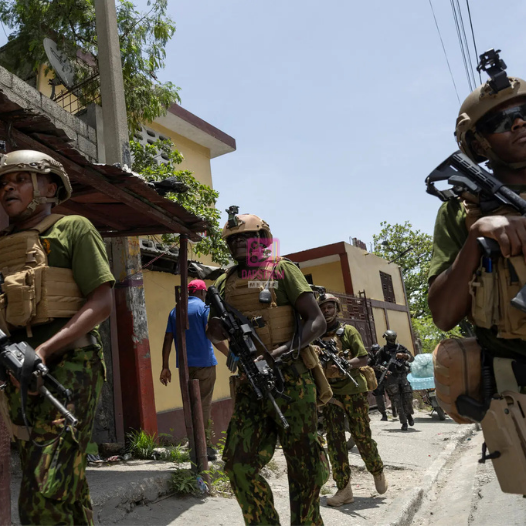
The reason behind the withdrawal is not a sudden decision but part of a planned transition. The MSS mission is being replaced by a broader, restructured force known as the Gang Suppression Force, which is expected to take over security operations. This new force, backed by the United Nations and involving multiple countries including Chad, is designed to be larger and better equipped, with a projected strength of about 5,500 personnel.
For Kenya, the withdrawal also signals the end of an 18-month deployment cycle, aligning with the mission’s initial timeline and broader international strategy. Officials have emphasized that the transition is necessary to allow a more robust and better-coordinated force to take over long-term stabilization efforts.
Yet, on the ground in Haiti, the transition feels anything but orderly. The mixed reactions among civilians—some celebrating the departure while others desperately trying to stop it—underscore the complexity of the situation. While critics of the mission see the withdrawal as the end of foreign intervention, many ordinary Haitians fear it could mark the beginning of renewed violence.
The protests blocking Kenyan police from leaving are therefore more than just demonstrations; they are a reflection of a population uncertain about its future. With gangs still wielding significant power and local security forces struggling with capacity issues, the fear of a security vacuum is real and immediate.
As the last Kenyan officers prepare to exit, the spotlight now shifts to whether the incoming international force can quickly fill the gap and maintain the fragile gains achieved. For the people on the streets of Haiti, however, the question is far more urgent: who will protect them when the last convoy finally leaves?