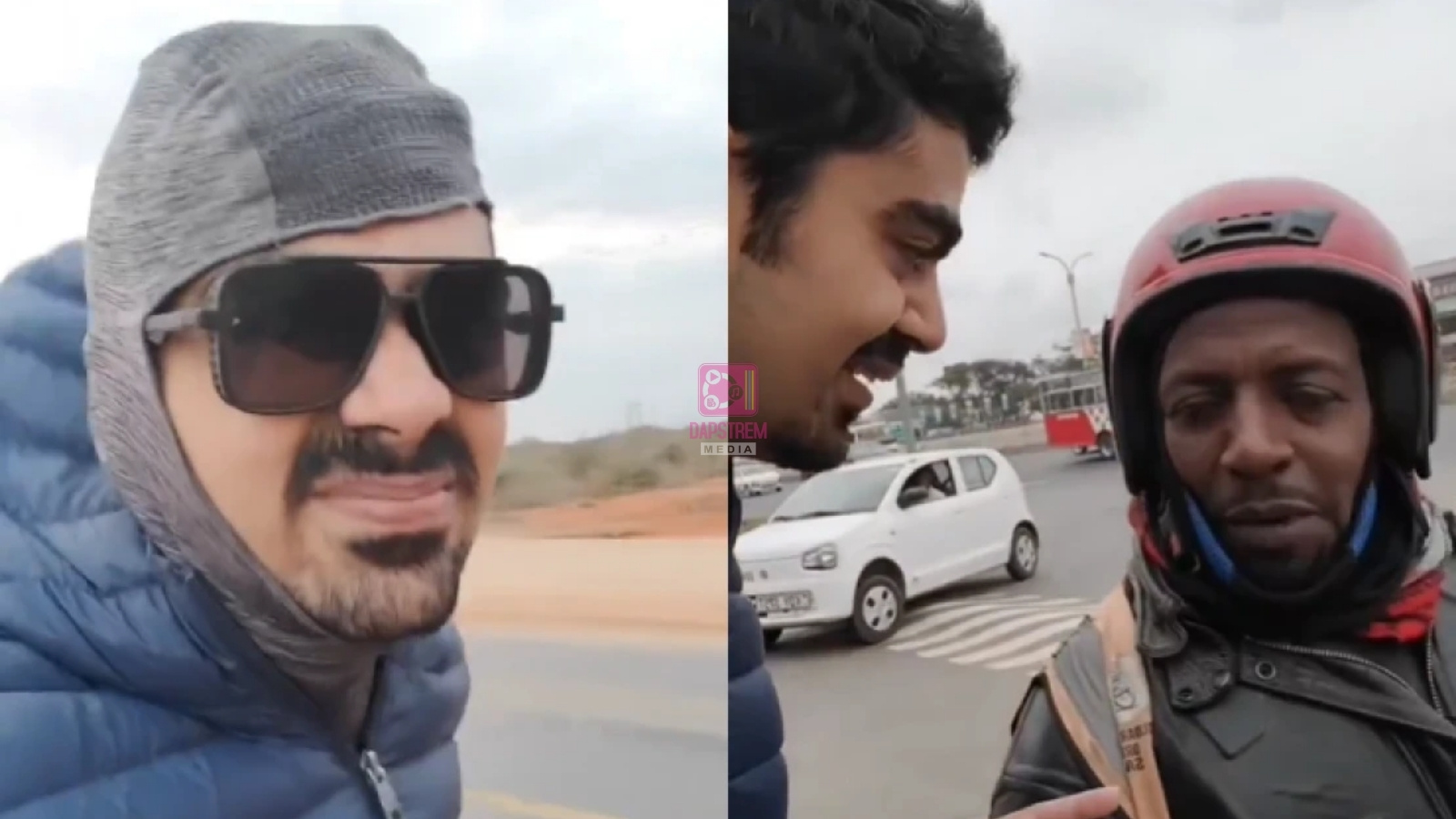
What began as an unusual request on a motorcycle-hailing app turned into a 13-hour road adventure that took one passenger and a boda-boda rider from Nairobi to Mombasa, covering roughly 490 kilometres along Kenya’s busy highway corridor.
The journey, undertaken by Indian content creator Rayan Parmar, popularly known online as Parmarcore, quickly captured the attention of Kenyans after videos documenting the trip circulated online.
Rather than taking the more conventional options of a bus, train, car or domestic flight, Parmar chose to travel to the Coast on the back of a motorcycle. Rider Job Njoroge accepted the unusual request through a ride-hailing platform, setting the pair on a journey that would test both rider and passenger.
They left Nairobi at about 9am and arrived in Mombasa at approximately 10pm, according to accounts of the trip.
The final fare displayed on the app was about KSh17,200, with an additional mobile-money transaction charge reported by the traveller.
An ordinary boda request takes an extraordinary turn
Boda-bodas are normally associated with short-distance urban journeys. In Nairobi, motorcycles have become an important part of the city’s transport system, helping passengers navigate traffic and reach areas that can be difficult to access by car.
The Nairobi County government describes motorcycles as a convenient means of moving through congested city streets and says regulations require riders to use safety equipment such as helmets and reflective jackets.
The Nairobi-to-Mombasa trip, however, was anything but an ordinary boda-boda journey.
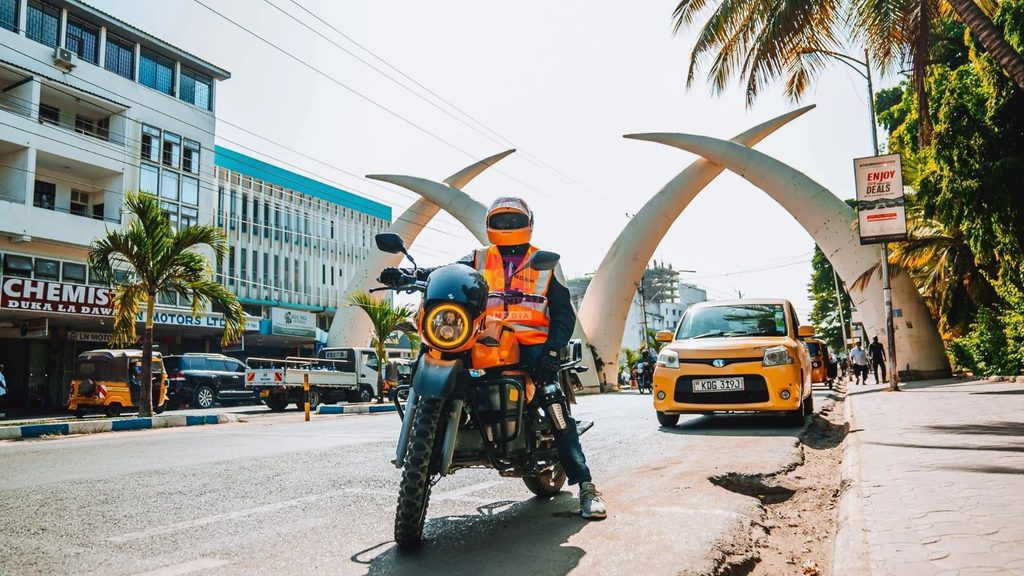
The approximately 490-kilometre route cuts through some of Kenya’s busiest transport corridors and takes travellers through changing terrain, towns and climate zones before reaching the Indian Ocean coast.
For Parmar, the attraction was apparently the experience itself.
During the journey, he was filmed expressing excitement about the unconventional adventure, joking about his decision while continuing down the highway.
The footage showed the pair making their way through traffic, stopping along the route and documenting the changing scenery. At one point, an update showed the fare had already climbed to more than KSh7,000 around Mariakani before the final stretch to Mombasa.
Thirteen hours on two wheels
The physical demands of the journey became one of the biggest talking points after the trip.
Spending 13 hours on a motorcycle is considerably different from travelling the same distance inside a bus or car. The passenger is exposed to wind, heat, rain, dust and road vibrations for much of the journey, while the rider must remain alert to traffic conditions throughout.
The route also includes long stretches shared with heavy trucks, buses and other vehicles.
Previous long-distance motorcyclists who have travelled the Nairobi-Mombasa route have described the physical strain of riding for extended periods, including fatigue, dehydration and the challenges of riding after dark.
A previous long-distance motorcycle journey documented by Business Daily described reaching Mombasa exhausted after travelling from Nairobi and highlighted the difficulties posed by darkness and interactions with heavy vehicles.
The recent journey similarly prompted online conversations about whether such a long trip is appropriate for a commercial motorcycle service.
The safety question
While the journey ended safely, it also raised legitimate road-safety questions.
The Nairobi-Mombasa highway is one of Kenya’s most important transport arteries but has also experienced serious crashes involving motorcycles, passenger vehicles and heavy trucks.
In December 2024, two Polish tourists were killed and others seriously injured when a truck collided with their vehicle on the highway. At the time, authorities described the route as one of the country’s more dangerous major roads. (apnews.com)
For motorcycle users, the risks can be greater because riders and passengers have considerably less physical protection in a collision.
The National Transport and Safety Authority has repeatedly emphasised road safety and the need for compliance with traffic regulations as part of efforts to reduce deaths and serious injuries on Kenyan roads.
That makes the Nairobi-Mombasa boda journey an interesting case study: it demonstrates what is physically possible on a motorcycle, but it should not necessarily be interpreted as a recommendation for routine long-distance commercial travel.
The price becomes part of the story
The journey’s cost generated almost as much discussion as the distance.
The final fare was reported at approximately KSh17,200.
That is substantially more than what many Kenyans would normally expect to pay for travelling between the two cities by conventional public transport, making the fare itself a central part of the viral story.
But the traveller was not simply paying for transportation. The journey had become an experience one that was filmed, shared and consumed by an online audience.
For Parmar, the price was seemingly part of the adventure.
For online observers, it became an opportunity to debate whether the fare represented an outrageous expense or a reasonable price for asking a rider to spend an entire day travelling hundreds of kilometres.
Nairobi’s Busy Streets to the Coast: A Boda-Boda Journey Like No Other
One of the most compelling elements of the journey was the transformation of the landscape.
The route begins amid Nairobi’s dense urban environment before opening into the wider landscapes of southeastern Kenya. The journey passes through towns such as Machakos and Voi before reaching the Coast, with the environment becoming progressively warmer as the motorcycle approaches Mombasa.
The traveller’s videos captured portions of this transition, giving viewers a moving perspective of a route that millions of Kenyans know primarily from buses, cars, trains and flights.
For someone accustomed to seeing the country through conventional travel, the motorcycle offered a completely different perspective.
Every stop, traffic jam, stretch of highway and roadside town became part of the experience.
Not Kenya’s first extreme motorcycle journey
Although Parmar’s ride went viral because it involved a commercial boda-boda booking, long-distance motorcycle travel is not new in Kenya.
Kenyan leisure riders have previously completed extraordinary journeys on motorcycles.
In 2024, leisure biker Mustafa Konvict reported riding from Nairobi to Mombasa and back, describing encounters with challenging conditions along the route. Another Kenyan rider completed a journey of more than 900 kilometres from Malaba to Mombasa on an electric motorcycle in 2025, using portable charging as part of an effort to demonstrate the potential of electric mobility.
What made the latest journey different was its connection to the app-based boda-boda economy.
It took a service designed largely around short urban trips and pushed it to an extreme distance.
Beyond the viral videos and jokes, the journey offers a glimpse into how deeply motorcycles have become embedded in Kenya’s transport culture.
Boda-bodas provide employment to thousands of riders and offer passengers an alternative to congested roads. Their popularity has grown particularly because motorcycles can move through traffic more easily than cars and can serve neighbourhoods where larger public-transport vehicles may not operate efficiently.
The same flexibility, however, can create unusual situations when technology, customer demand and individual willingness intersect.
A passenger can request an unconventional journey. A rider can decide to accept it. An algorithm can calculate the fare. And suddenly a platform built around urban mobility becomes the booking mechanism for a nearly 500-kilometre cross-country journey.
That is precisely what happened in this case.
An adventure and a cautionary tale
By the time Parmar and Njoroge reached Mombasa, the extraordinary ride had become a viral Kenyan story.
The passenger had experienced Kenya from a completely different vantage point, while the rider had completed an unusually demanding assignment that took him across much of the country’s most important road corridor.
The trip ended safely, but its viral success should not obscure the risks involved.
Long-distance motorcycle travel requires careful planning, adequate rest, mechanical checks, appropriate protective equipment and constant attention to road conditions. Fatigue is particularly important because a rider’s concentration can deteriorate during prolonged periods on the road.
For the thousands of ordinary boda-boda riders who make their living on motorcycles, safety remains more important than speed or novelty.
The Nairobi-to-Mombasa ride may have started as an impulsive request, but it became something much bigger: a remarkable travel story, a social-media sensation and a reminder of just how far Kenya’s boda-boda culture can stretch.
From the crowded streets of Nairobi to the warm air of Mombasa, the journey covered nearly 500 kilometres not by bus, train or plane, but on the back of a motorcycle.
And that, more than the KSh17,200 fare, may be the reason Kenyans could not stop talking about it.