

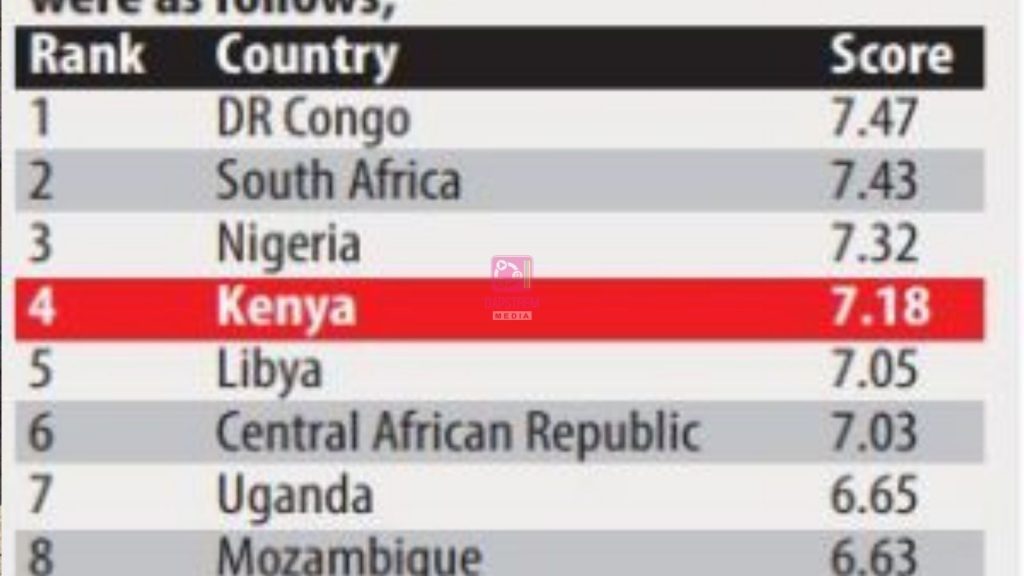
Kenya ranks 11th globally on the Global Organised Crime Index with a criminality score of 7.18, highlighting persistent challenges posed by organised criminal networks and the need for stronger institutional resilience.
Kenya has been ranked among the countries with the highest levels of criminality in the world after placing 11th globally in the latest Global Organised Crime Index, recording a criminality score of 7.18. The ranking places Kenya among a small group of nations facing significant challenges related to organised crime, highlighting concerns over the activities of criminal networks and the impact they continue to have on security, governance, and economic development.
The findings, published by the Global Organised Crime Index, provide a comprehensive assessment of organised crime and criminal markets across countries worldwide. The report measures the extent of criminal activity as well as the resilience of governments and institutions in responding to organised crime. Kenya’s position in the latest rankings has sparked renewed debate about the country’s security landscape and the need for stronger efforts to combat sophisticated criminal enterprises.
A criminality score of 7.18 indicates a high level of organised criminal activity. The index evaluates countries based on the presence and influence of criminal actors, the scale of illegal markets, and the degree to which organised crime affects governance, communities, and the economy. The report does not measure ordinary crime alone but focuses on criminal networks that operate systematically, often across borders and through complex financial and logistical systems.
Kenya’s ranking reflects challenges that have developed over many years as the country has grown into one of East Africa’s largest commercial and transport hubs. Its strategic location, modern transport infrastructure, busy ports, extensive road networks, and international airports have made it an important gateway for trade across the region. However, these same advantages have also been exploited by organised criminal groups involved in various illicit activities.
Among the criminal markets commonly assessed by the Global Organised Crime Index are drug trafficking, human trafficking, human smuggling, arms trafficking, environmental crimes, financial crimes, cybercrime, extortion, and illicit trade in natural resources. Criminal groups often operate across national borders, making investigations and prosecutions particularly challenging for law enforcement agencies.
Drug trafficking remains one of the most significant concerns highlighted in discussions surrounding organised crime in East Africa. Kenya’s position along the Indian Ocean coastline has historically made it an important transit point for international narcotics destined for markets in Africa, Europe, Asia, and the Middle East. Authorities have, over the years, intercepted large quantities of illegal drugs at ports, airports, border crossings, and along the country’s coastline.
Financial crimes also continue to present serious challenges. Criminal enterprises increasingly rely on sophisticated money laundering schemes, fraudulent financial transactions, identity theft, cyber-enabled fraud, and illegal financial networks to conceal proceeds generated from illicit activities. As financial systems become more digitized, organised criminal groups have adapted by using technology to move money across jurisdictions while attempting to avoid detection.
Cybercrime has emerged as another growing concern. Increased internet connectivity, digital banking, mobile money services, and online commerce have created new opportunities for criminals to exploit individuals, businesses, and public institutions. Cases involving online fraud, phishing scams, ransomware attacks, identity theft, and unauthorized access to digital systems have become more common in many countries, including Kenya.
Human trafficking and human smuggling also remain major regional and global concerns. Organised criminal networks exploit vulnerable individuals through forced labour, sexual exploitation, illegal migration schemes, and other forms of exploitation that generate significant illegal profits. International agencies continue working closely with governments to identify victims, dismantle trafficking networks, and strengthen cross-border cooperation.
Environmental crimes have likewise gained increasing international attention. Illegal logging, wildlife trafficking, illicit charcoal trade, illegal fishing, and other environmental offences not only damage ecosystems but also provide substantial income for organised criminal groups. Kenya has made considerable efforts in recent years to combat wildlife trafficking, particularly through enhanced enforcement aimed at protecting endangered species.
The Global Organised Crime Index evaluates more than just criminality. It also assesses how resilient countries are in responding to organised crime through effective institutions, law enforcement, judicial independence, anti-corruption measures, international cooperation, financial oversight, victim protection, and public accountability. Strong resilience can help reduce the long-term impact of organised crime even where criminal activity remains significant.
Kenya has undertaken numerous initiatives over the years to strengthen its capacity to combat organised crime. Law enforcement agencies have invested in intelligence-led policing, improved forensic capabilities, enhanced border surveillance, financial investigations, and international cooperation with regional and global partners. Specialized units have also been established to address cybercrime, terrorism financing, money laundering, wildlife crimes, and transnational criminal networks.
Regional cooperation has become increasingly important in tackling organised crime because many criminal enterprises operate across multiple countries. Kenya works closely with neighbouring states, regional organizations, and international law enforcement bodies to exchange intelligence, coordinate investigations, and disrupt cross-border criminal activities.
Despite these efforts, experts acknowledge that organised crime continues evolving rapidly. Criminal groups often exploit technological advances, weak regulatory systems, corruption, porous borders, and global financial networks to expand their operations. This requires governments to continuously strengthen legislation, modernize investigative techniques, and invest in advanced technologies capable of detecting increasingly sophisticated criminal activities.
The economic consequences of organised crime are substantial. Illicit markets deprive governments of tax revenue, discourage legitimate investment, distort competition, undermine public confidence in institutions, and increase the cost of doing business. Businesses affected by fraud, extortion, smuggling, or counterfeit goods often face significant financial losses, while consumers may be exposed to unsafe products and services.
Communities also bear the social costs of organised crime. Criminal networks can contribute to violence, insecurity, corruption, exploitation, and weakened public trust in government institutions. In some cases, organised crime may intersect with terrorism, political instability, or local conflicts, further complicating national security efforts.
The publication of the Global Organised Crime Index is expected to renew policy discussions on how Kenya can further strengthen its response to organised criminal activity. Analysts argue that effective solutions require not only stronger law enforcement but also investments in education, employment opportunities, judicial reforms, anti-corruption initiatives, financial transparency, and community-based prevention programmes.
Technology is expected to play an increasingly important role in future crime prevention strategies. Artificial intelligence, digital surveillance systems, biometric identification, financial intelligence platforms, and improved data sharing between institutions may enhance the ability of authorities to identify criminal patterns and disrupt illicit operations before they expand.
International cooperation will remain equally essential. Since organised crime frequently crosses national boundaries, no single country can effectively address the challenge in isolation. Collaborative investigations, intelligence sharing, extradition agreements, and coordinated legal frameworks remain among the most effective tools for dismantling transnational criminal organisations.
The latest ranking should not be viewed solely as a measure of criminal activity but also as an opportunity to strengthen national resilience. Countries that continuously invest in institutional reforms, transparent governance, accountable policing, efficient courts, and effective financial oversight are generally better positioned to reduce the long-term influence of organised crime.
For Kenya, the report serves as a reminder that safeguarding national security extends beyond traditional policing. Addressing organised crime requires coordinated action involving government agencies, the private sector, civil society, regional partners, and ordinary citizens. Public awareness, stronger institutions, improved reporting mechanisms, and sustained political commitment all contribute to creating an environment where organised criminal networks find it increasingly difficult to operate.
As policymakers review the latest findings, attention is likely to focus on enhancing enforcement while simultaneously addressing the social and economic conditions that organised criminal groups often exploit. Continued investment in security, governance, technology, and international partnerships will be essential if Kenya is to improve its standing in future editions of the Global Organised Crime Index.
Ultimately, Kenya’s placement as the 11th most criminally affected country according to the Global Organised Crime Index highlights the scale of the challenge posed by organised crime. At the same time, it underscores the importance of sustained reforms, regional cooperation, and stronger institutions in protecting citizens, strengthening the rule of law, and promoting long-term economic growth and national security.