
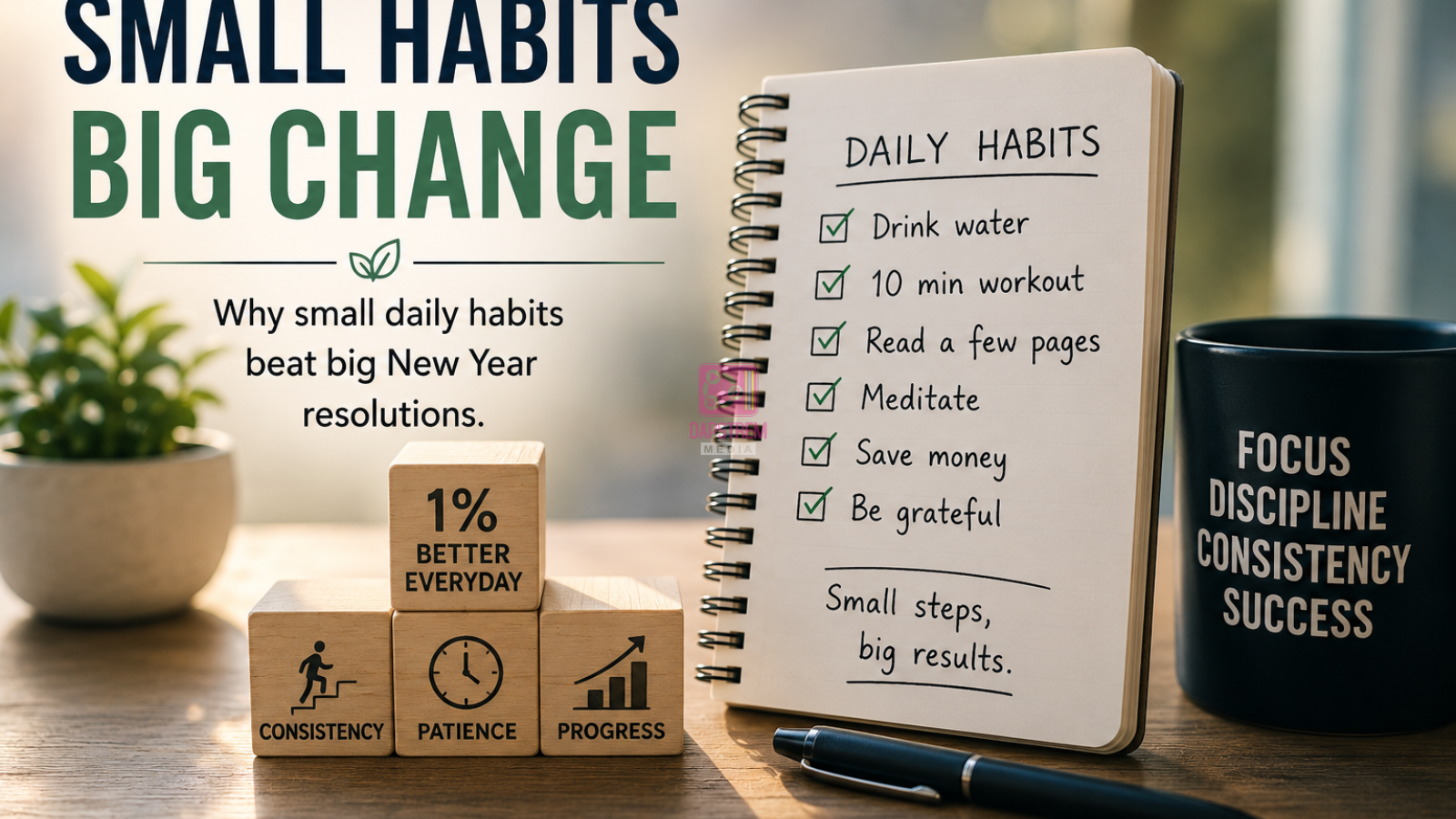
Why Consistency and Small Daily Actions Create Lasting Change While Big Resolutions Often Fail
Every year, millions of people around the world make bold New Year’s resolutions—promises to lose weight, start exercising, save more money, read more books, wake up earlier, or completely transform their lives. Yet, by February, most of these resolutions have already been abandoned or significantly reduced. The enthusiasm fades, motivation drops, and life returns to familiar routines.
This raises an important question: why do big resolutions so often fail, while small daily habits tend to succeed?
The answer lies in psychology, human behavior, and how lasting change actually happens. Sustainable transformation is rarely the result of sudden, dramatic shifts. Instead, it is built through small, consistent actions repeated over time. In other words, habits—not resolutions—shape long-term success.
At the heart of this idea is the principle that humans are wired for routine. Our brains are designed to conserve energy by automating repeated behaviors. When something becomes habitual, it requires less mental effort, fewer decisions, and far less motivation. This is why brushing your teeth, checking your phone, or making morning tea feels effortless—you don’t need to “motivate” yourself to do it. It is already part of your system.
Big New Year resolutions fail because they rely heavily on motivation rather than structure. Motivation is temporary. It fluctuates based on mood, stress, environment, and energy levels. A person may feel extremely inspired on January 1st, but that emotional peak naturally declines over time. When motivation fades, the resolution loses its foundation.
Small daily habits, however, do not depend on motivation alone. They rely on repetition and identity. Instead of saying “I want to become fit,” a person who builds habits thinks, “I am someone who moves every day.” That shift in identity is powerful because it changes behavior at a subconscious level. You no longer rely on willpower; you rely on who you believe you are becoming.
For example, someone trying to “get fit this year” might sign up for a gym membership, create an intense workout schedule, and aim for rapid transformation. But this approach is often overwhelming. Missing one or two sessions feels like failure, and discouragement builds quickly. On the other hand, someone who commits to just 10 minutes of walking daily is far more likely to stay consistent. Over time, that small habit naturally expands into longer walks, jogging, or structured workouts. The transformation becomes gradual but sustainable.
This is where the concept of compound growth becomes important. Just like saving small amounts of money daily can grow into significant wealth over time, small habits compound into major life changes. A person who reads 10 pages a day may finish dozens of books in a year. Someone who saves a small amount daily builds financial stability without feeling pressure. Someone who writes a few paragraphs each day can eventually produce entire books or careers in writing.
The key difference is that habits work in the background. They do not demand dramatic effort or emotional intensity. Instead, they integrate into daily life until they become automatic. Once a habit is formed, consistency no longer feels like a struggle.
Another reason small habits win is that they reduce the risk of burnout. Big resolutions often create extreme pressure. People try to change too much at once—dieting strictly, exercising intensely, waking up early, cutting sugar, and learning new skills all at the same time. This overload leads to fatigue and eventual collapse. Small habits, however, allow gradual adaptation. The brain and body adjust slowly, making long-term adherence more realistic.
Environment also plays a major role in habit formation. It is easier to maintain small habits when the environment supports them. For example, placing a water bottle on your desk increases the likelihood of drinking more water. Keeping a book on your bedside table encourages reading. Reducing friction—by making good habits easier and bad habits harder—is one of the most effective strategies for long-term change.
In contrast, New Year resolutions often ignore environment design. They rely on sudden discipline rather than structured support. Without changing surroundings or systems, old habits quickly take over.
Another important factor is feedback. Small habits provide immediate, visible progress. Each day completed creates a sense of achievement, reinforcing motivation. Big resolutions, however, often delay results. Someone trying to lose weight may not see changes for weeks, leading to frustration and loss of interest. But someone tracking daily habits—like steps walked, water consumed, or pages read—feels progress immediately.
This is why behavioral scientists often emphasize systems over goals. A goal is an outcome, but a system is the process that leads to that outcome. New Year resolutions are goal-focused: “I want to lose 10 kilograms” or “I want to save money.” Small habits are system-focused: “I will walk 20 minutes daily” or “I will save a fixed amount every day.” Systems create consistency; goals only create direction.

Cultural expectations also play a role in the popularity of New Year resolutions. The beginning of the year feels symbolic, like a fresh start. This creates emotional excitement, but it also creates unrealistic expectations. People expect transformation to happen quickly, almost instantly. When reality does not match expectation, disappointment sets in.
Small habits remove this pressure. They do not rely on perfect timing or special moments. They can begin on any day, at any time, without ceremony. This flexibility makes them more adaptable to real life, where schedules change, challenges arise, and motivation fluctuates.
Over time, small habits reshape identity. A person who writes daily becomes a writer. A person who exercises regularly becomes someone who values fitness. A person who reads consistently becomes a learner. These identity shifts are far more powerful than temporary goals because they influence future behavior automatically.
In contrast, New Year resolutions often fail because they remain external goals rather than internal identity changes. Once the excitement fades, there is nothing left to sustain the behavior.
Ultimately, the difference between success and failure is not intensity but consistency. Big changes are rarely achieved through sudden effort alone. They are built through small, repeated actions that accumulate over time.
The lesson is simple but powerful: instead of waiting for a new year to change your life, start with one small habit today. Not something overwhelming, but something so small that it feels almost too easy to fail. Because when something is easy, it is easier to repeat. And when it is repeated, it becomes part of who you are.
In the long run, it is not the big resolutions that shape your life. It is the small things you do every single day.