The Republic of Ireland’s 3-0 Nations League victory over Israel in Debrecen, Hungary, was about far more than three points.
For months, the fixture had been one of the most politically charged matches in European football. By kick-off on Sunday, the controversy had reached the Irish dressing room itself, with goalkeeper Gavin Bazunu withdrawing from the squad and the remaining players holding a vote on whether they should play.
They eventually did but not without making their opposition to the circumstances surrounding the fixture visible.
Ireland’s players wore black armbands in recognition of lives lost in the Gaza conflict, bowed their heads during Israel’s national anthem and declined the traditional pre-match handshakes and exchange of pennants. On the pitch, meanwhile, they produced an emphatic performance, scoring three times in the opening 25 minutes.
Afterwards, Ireland manager Heimir Hallgrimsson argued that the players had succeeded in doing something that protest movements seek to achieve: attracting attention.
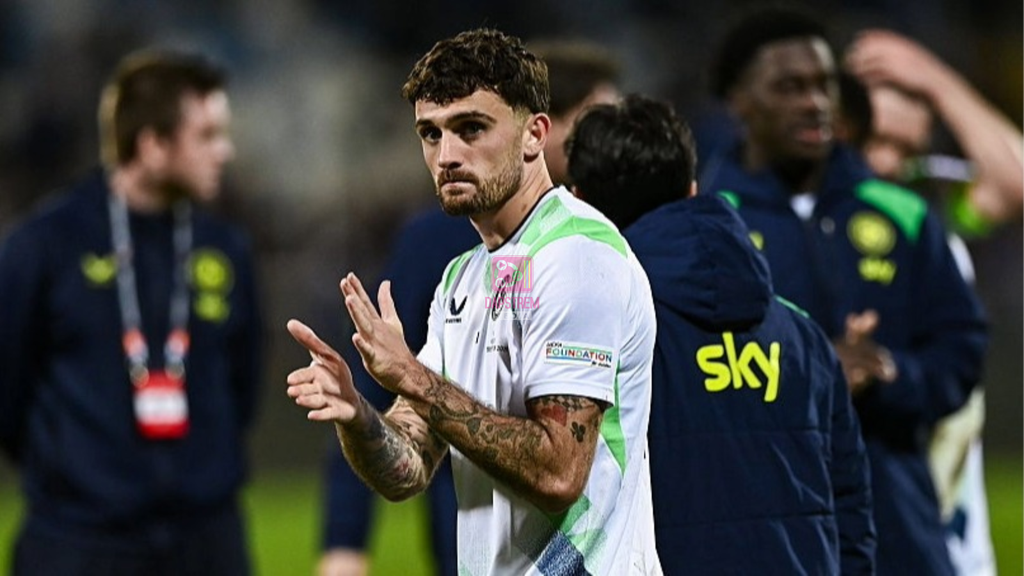
“They have raised awareness worldwide, not only in Ireland, worldwide on the subject,” Hallgrimsson told RTÉ.
His comment captured the unusual character of the evening. Ireland had decided to fulfil a fixture many of its supporters wanted cancelled, yet the players still used the occasion to make their position visible.
A match that had been controversial for months
The dispute did not begin in Debrecen.
Ireland and Israel were drawn together in the UEFA Nations League earlier this year, immediately placing the Football Association of Ireland (FAI) in a difficult position.
In November 2025, the FAI had voted to ask UEFA to suspend Israel from European competition. The association cited alleged breaches of UEFA statutes concerning Israeli clubs playing in occupied Palestinian territory and the Israeli Football Association’s approach to anti-racism measures. The Israeli side rejected the accusations.
The FAI nevertheless decided that Ireland would fulfil the Nations League fixtures.
That decision triggered a sustained campaign for a boycott. During Ireland’s May friendly against Qatar, supporters repeatedly threw tennis balls decorated with Palestinian imagery onto the pitch, forcing interruptions to the match. More than 160 Irish sportspeople subsequently signed an open letter urging the men’s team to refuse to play Israel.
The controversy also influenced where the matches would be played.
Israel’s designated home fixture was moved to Debrecen, while Ireland’s nominal home match on 4 October was moved from Dublin to Bačka Topola in Serbia and is scheduled to be played behind closed doors. The FAI also confirmed that Irish supporters would not be sold tickets for the first fixture.
UEFA said decisions concerning the separation of teams in future draws are considered individually, particularly according to security considerations.
The decision nearly collapsed
The most dramatic moment came less than 24 hours before Sunday’s match.
Ireland’s scheduled press conference and training session were delayed as the squad discussed whether it could, or should, fulfil the fixture.
Bazunu subsequently confirmed that he had withdrawn from the squad.
“I have reached a decision that I have not taken lightly,” the goalkeeper said, explaining that he believed it would be wrong for him to participate in the matches in light of the situation in the region.
The FAI then revealed that the players themselves had voted on whether the fixtures should proceed.
Chief executive David Courell described the result as a “significant majority” in favour of playing. The exact vote was not disclosed.
That decision did not mean the controversy had disappeared. Rather, the players and FAI attempted to distinguish between fulfilling the sporting obligation and remaining silent about the wider political and humanitarian situation.
The players agreed to wear black armbands, make charitable contributions and abandon some of the customary pre-match rituals.
The message before kick-off
When the teams emerged at the Nagyerdei Stadion, there was little of the normal ceremony.
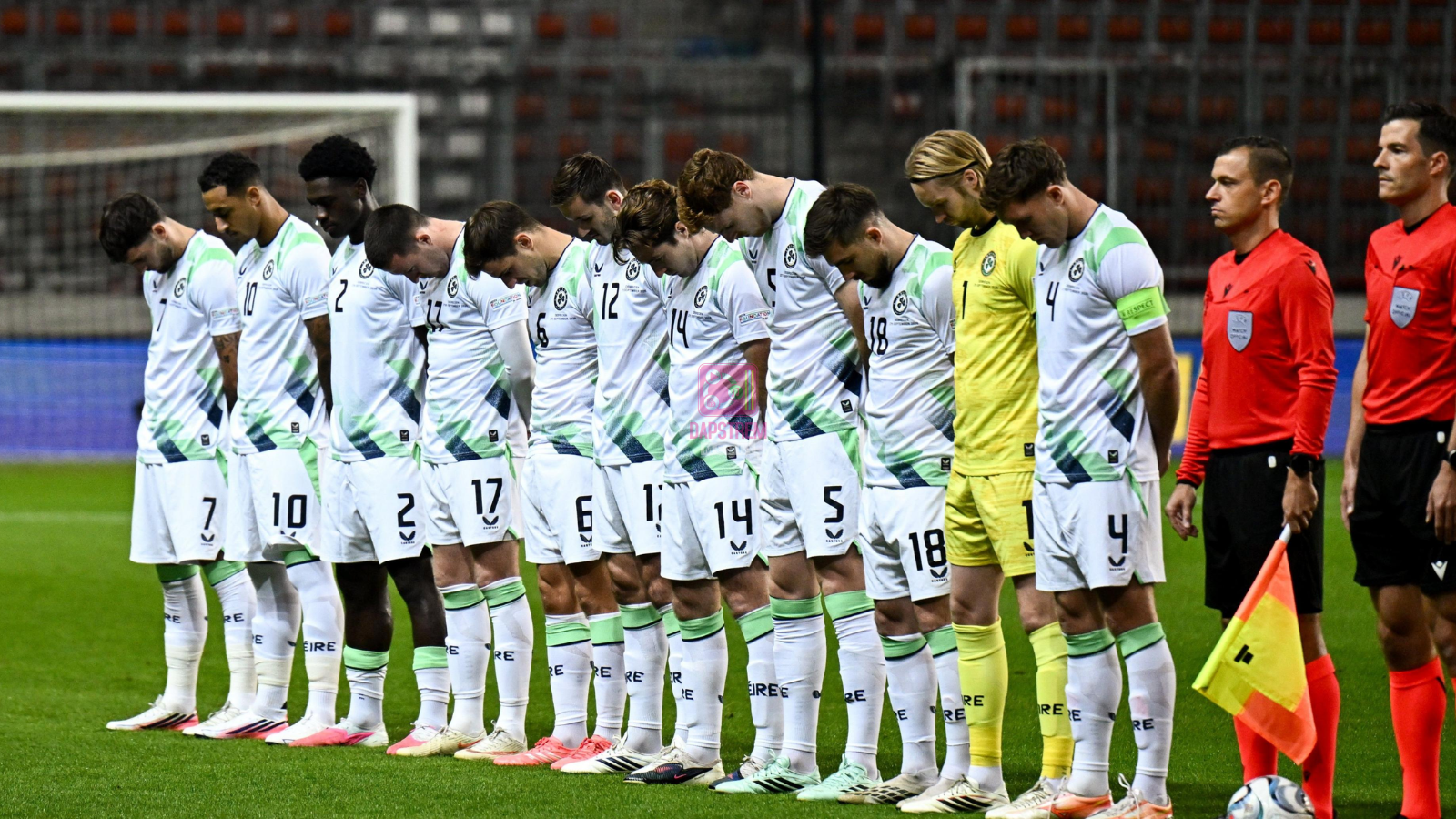
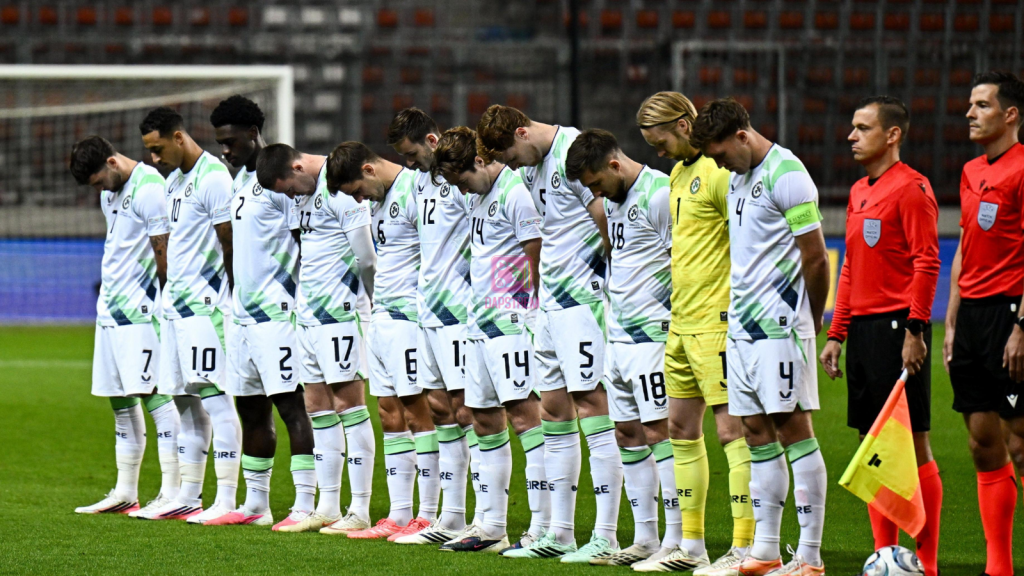
Ireland’s players did not shake hands with their Israeli opponents. There was no exchange of pennants between the captains.
Then came the national anthems.
While Israel’s anthem played, the Irish players stood with their heads bowed. They wore the black armbands that had been agreed upon as a tribute to those killed in the conflict.
The symbolism was difficult to miss, particularly in a largely empty stadium.
Only a few hundred Israeli supporters and a small number of Irish fans were present. The FAI had not made tickets available to Irish supporters, and the subdued atmosphere meant that players and coaches could be heard clearly around the stadium.
The Israeli Football Association had previously described the decision to play as a victory for the sport, with its communications chief Shlomi Barzel saying that “football has won”.
The Irish players’ actions, however, ensured that the political dispute remained visible even after the decision to play had been made.
Then Ireland took control
Once the match began, the football itself became remarkably one-sided.
Troy Parrott opened the scoring in the 14th minute, finishing for his 12th international goal.
Two minutes later, Adam Idah doubled the advantage.
And in the 25th minute, Jack Moylan made it 3-0 with a well-taken finish.
Moylan’s celebration became another notable image of the night.
After scoring, he removed his black armband, kissed it and then kissed the Ireland badge on his shirt. He subsequently directed the armband towards the Israeli supporters.
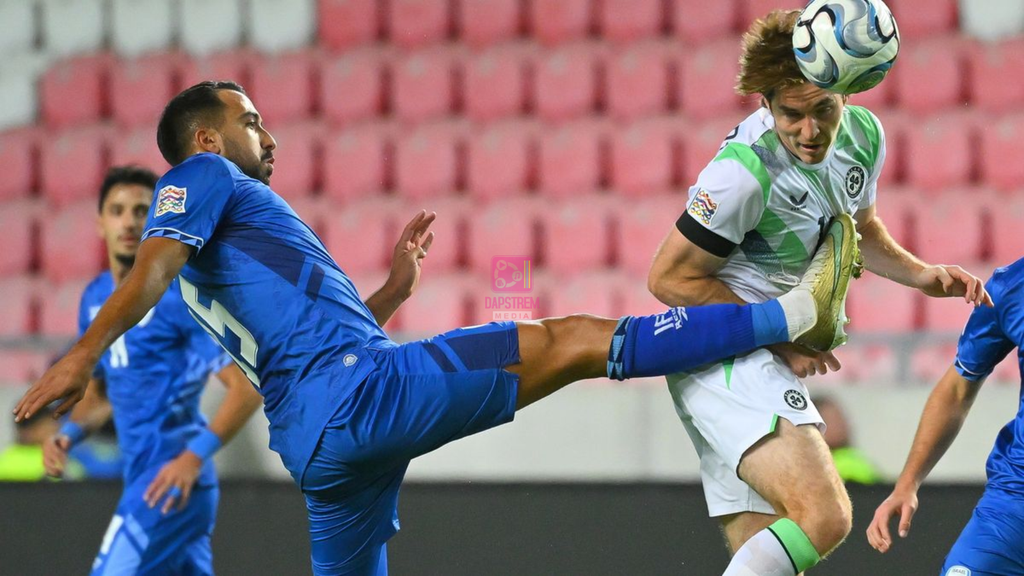
Ireland did not add to the score after half-time, but the damage had already been done.
For Hallgrimsson, the performance mattered because his players had entered the game under extraordinary pressure.
They had lost 1-0 to Kosovo only three days earlier. They had spent much of Saturday debating whether to participate against Israel. One of their goalkeepers had withdrawn. And the squad had been subjected to intense scrutiny from supporters, politicians and media.
Instead, Ireland produced its most convincing performance of the Nations League campaign.
Hallgrimsson’s change of emphasis
The Irish manager had himself become part of the controversy during the week.
Asked about preparing his players for the Israel fixtures, Hallgrimsson had said:
“We’re not playing with genocide, we’re playing against genocide.”
The Israeli Football Association responded with an unusually personal attack, accusing the Irish manager of “stupidity, ignorance and hypocrisy”. Hallgrimsson subsequently acknowledged that his choice of words had been unwise because it had diverted attention from Ireland’s football preparations.
After Sunday’s match, his emphasis was different.
Rather than presenting the players’ actions as a political victory, he focused on their ability to express themselves through their conduct while still representing Ireland.
He said the squad had supported the right to protest, but argued that criticism should not spill over into pressure on players and their families.
“They have shown support to the protest,” Hallgrimsson said. “They have raised awareness worldwide, not only in Ireland, worldwide on the subject.”
The players had not boycotted the match. They had not refused to represent their country. But neither had they treated the fixture as an ordinary international.
Ireland’s position has a longer history
The reaction should also be understood against Ireland’s longstanding public and political support for the Palestinian cause.
Irish football has frequently provided a particularly visible platform for that sentiment. Palestinian flags and banners have appeared regularly at League of Ireland matches, while supporters have staged demonstrations at international games.
The FAI’s own actions have also gone beyond the events of this Nations League campaign.
The association’s previous attempt to have UEFA suspend Israel, combined with its decision to move the October fixture away from Dublin, illustrates the tension between its institutional position and its decision to continue playing the matches.
That tension became particularly apparent when the FAI held an extraordinary general meeting in July.
Delegates voted 75-32, with three abstentions, in favour of proceeding with the Israel fixtures. Irish Sport for Palestine criticised the decision, saying it did not reflect the wishes of the Irish public or professional players.
The political dispute remains unresolved
Sunday’s 3-0 result settled one question: Ireland had fulfilled the first fixture.
It did not settle the larger argument.
Ireland is scheduled to meet Israel again on 4 October in Bačka Topola, Serbia. That match will be played behind closed doors, meaning another politically sensitive occasion is already on the horizon.
The response from the Irish public has also demonstrated how divisive the fixtures remain. Ahead of Sunday’s game, protests continued and some Irish pubs chose not to show the match. Al Jazeera reported that one campaign organiser had identified around 140 pubs and bars refusing to screen it.
For the players, however, the immediate task was to get through a uniquely difficult international window.
It would be too simple to describe the night solely as an Irish football victory, just as it would be inaccurate to portray it solely as a political protest.
It was both a sporting event and an expression of the extraordinary political circumstances surrounding it.
Ireland chose to play.
Bazunu chose not to.
The remaining players chose to participate after an internal vote, but they also chose to bow their heads during Israel’s anthem, wear black armbands and dispense with the normal handshakes and ceremonial exchanges.
And then they scored three times before half-time.
That combination explains Hallgrimsson’s assertion that his players had “raised awareness worldwide”.
Whether one views the gestures as protest, solidarity or simply a personal expression of conscience, they ensured that the political controversy did not disappear when the referee blew the whistle.
Instead, the match became another international stage on which Ireland’s players, their football association and their opponents publicly confronted the difficult question that had surrounded the fixture from the beginning: can sport be separated from the political circumstances in which it is played?