
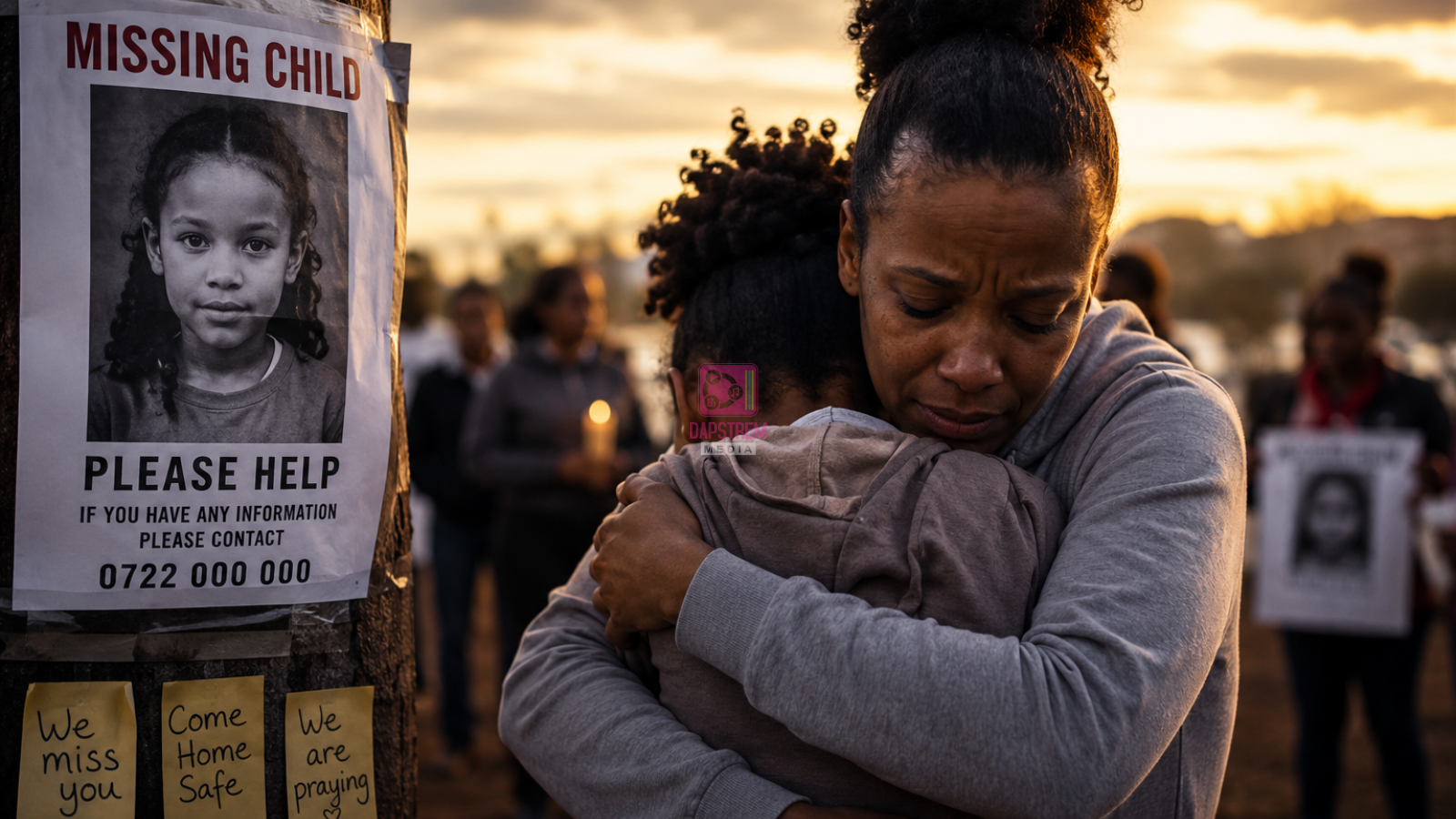
How a Missing Child Leaves a Family Living Between Hope and Uncertainty for Years
Few experiences reshape a family’s life as profoundly and permanently as the disappearance of a child. It is a kind of pain that does not follow a straight line, does not respect time, and does not settle into a clear ending. When a child goes missing, whether through abduction, getting lost, trafficking, or unexplained disappearance, the family is suddenly suspended between hope and despair, forced into a reality where every unanswered question becomes heavier than the last.
In recent years, Kenya and many other countries have witnessed disturbing reports of children disappearing under different circumstances—some while on their way to or from school, others while playing near home, and others in crowded public places where a brief moment of distraction is all it takes for tragedy to unfold. These incidents, often reported in newspapers, social media posts, and police bulletins, have left families searching desperately for answers, sometimes for days, months, or even years. Each case carries its own story, but together they reveal a painful truth: no family is fully prepared for the disappearance of a child.
When a child goes missing, the immediate reaction is disbelief. Parents often replay the last moments they saw their child, trying to identify what they might have missed or done differently. A parent may recall a school morning where everything seemed normal, a goodbye at the gate, or a phone call that never came. This mental replay becomes a cycle that is difficult to escape, as the mind searches endlessly for clues that might explain what went wrong.
In many cases reported across communities, families first assume the child is simply late or temporarily unreachable. A delay in returning home from school or an unexplained absence from a familiar place can initially be mistaken for normal childhood behavior. But as minutes turn into hours, and hours into days, fear begins to replace uncertainty. Phone calls to friends, relatives, teachers, and neighbors yield no answers. That is often the moment when panic fully sets in.
The emotional impact of a missing child spreads quickly through an entire household. Parents often experience intense guilt, even when there is no clear reason to blame themselves. Mothers may feel an overwhelming sense of helplessness, while fathers may struggle with anger and frustration directed at authorities, society, or even themselves. Siblings are also deeply affected, often struggling to understand why their brother or sister has not returned home and whether they are safe.
Beyond the immediate family, the wider community is often drawn into the search. In many recent cases across Kenya, including reports of children disappearing in urban estates, rural villages, and school environments, communities have mobilized through search parties, social media alerts, and public announcements. WhatsApp groups, Facebook posts, and local radio stations become tools of urgency, spreading photos and descriptions in the hope that someone, somewhere, has seen the missing child.
Despite these efforts, the uncertainty can persist. Some children are found safe after a few hours or days, often having simply lost their way or stayed longer than expected with friends. However, other cases remain unresolved, and it is these situations that leave the deepest scars. Families are left in a painful limbo, unable to mourn but also unable to live normally, holding on to hope while fearing the worst.
The psychological toll of such experiences is long-lasting. Even when a child is eventually found, the trauma does not simply disappear. Families often report heightened anxiety, overprotectiveness, and fear of letting children out of sight. Normal activities such as going to school, visiting friends, or playing outdoors can become sources of stress rather than joy. The sense of safety that once existed is fundamentally altered.
In cases where children remain missing for extended periods, families may experience what psychologists describe as “ambiguous loss,” a state where there is no closure because the fate of the child is unknown. Unlike confirmed loss, where mourning follows a defined process, ambiguous loss leaves families trapped in uncertainty. Hope and grief exist simultaneously, making emotional recovery extremely difficult.
Recent incidents reported in different parts of the country have intensified public awareness about child safety. Cases of children disappearing on their way to school, being separated from guardians in crowded markets, or going missing during travel have sparked conversations about the need for stronger protective measures. In some instances, schools have issued warnings to parents about ensuring children are picked up safely, while authorities have increased patrols in areas considered high-risk.
The rise of urban populations and increased mobility has also contributed to new safety challenges. Children in busy towns and cities are often exposed to environments where it is easy to get lost or separated from caregivers. Markets, bus stations, shopping centers, and even school environments can become overwhelming for younger children. A single moment of distraction can lead to separation, and in crowded settings, reuniting can become difficult.
Technology has played a double-edged role in these situations. On one hand, social media has become a powerful tool for spreading missing child alerts quickly. On the other hand, the speed at which information spreads can sometimes lead to misinformation, confusion, or false hopes. Nevertheless, many families credit online communities with helping locate missing children faster than traditional methods alone.
Law enforcement agencies have also been increasingly involved in responding to missing child cases. Police reports, search operations, and coordination with community leaders are now standard responses. However, challenges such as delayed reporting, limited resources, and jurisdictional constraints can sometimes slow down investigations. Families are often advised to report missing children immediately rather than waiting, as the first few hours are considered critical.
At the heart of every missing child case is a family that is fundamentally changed, regardless of the outcome. Even when children return safely, the experience leaves emotional marks that may last a lifetime. Trust in public spaces is weakened, parental vigilance increases, and families often reassess their routines and safety practices.
In cases where children are not found, the impact becomes even more profound. Homes that were once filled with laughter can become quiet and emotionally heavy. Celebrations lose meaning, routines are disrupted, and milestones such as birthdays become painful reminders of absence. Parents often describe living in a state of “waiting,” hoping for a knock on the door or a phone call that brings news of their child.
Communities, too, are affected. A missing child case often creates collective anxiety, especially when multiple incidents are reported within a short period. Schools may heighten security measures, neighborhoods may become more cautious, and caregivers may restrict children’s movements more than before. This shared sense of vulnerability reflects how deeply such incidents affect society as a whole.
Experts emphasize that preventing child disappearance requires a combination of awareness, supervision, education, and community involvement. Teaching children basic safety rules, ensuring they understand how to seek help, and maintaining communication between parents and schools are all important steps. Communities are also encouraged to look out for one another, particularly in busy public spaces where children may easily become separated.
While no system can completely eliminate the risk, stronger coordination between families, schools, law enforcement, and community networks can significantly reduce it. The emotional and psychological consequences of missing children are too severe to be left unaddressed or underestimated.
Ultimately, the story of a missing child is not just about disappearance—it is about transformation. It is about how ordinary families are thrust into extraordinary emotional journeys that reshape their understanding of safety, trust, and hope. It is about nights filled with unanswered questions, days spent searching, and lives divided into “before” and “after.”
Every reported case reminds society of the fragility of everyday moments. A child walking to school, playing outside, or visiting a neighbor may seem routine, yet these are the moments where vigilance matters most. The hope shared by every affected family is simple but powerful: that no parent should ever have to endure the silence of a missing child, and that every effort must be made to ensure children are safe, protected, and always accounted for.
Until that hope is fully realized, families will continue to carry the emotional weight of uncertainty, and communities will continue to be reminded that the safety of children is not just a personal responsibility, but a collective one that defines the strength and compassion of society itself.