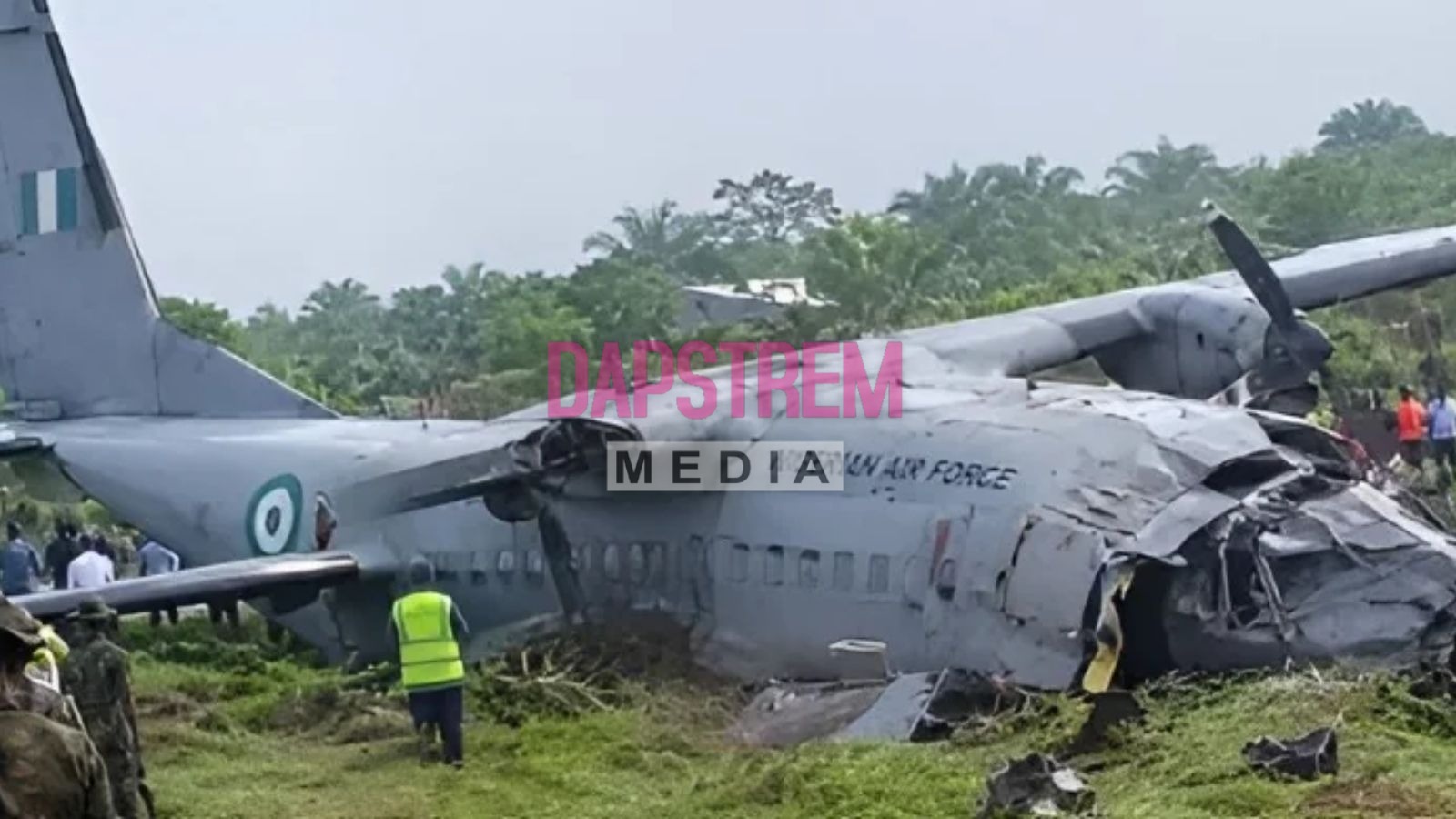
Nigeria Mourns 25 Lives Lost in Tragic Air Force Crash as Investigators Probe Cause of Deadly Ondo Aircraft Disaster
Nigeria is mourning the deaths of 25 people after a Nigerian Air Force aircraft crashed in Ondo State while travelling from Benin City to Lagos on a routine mission.
The Nigerian Air Force confirmed on Tuesday that there were no survivors after the ATR-42 aircraft, identified as NAF 931, went down in the Igbokoda area of Ilaje Local Government Area in Ondo State.
The aircraft was carrying five crew members and 20 passengers when it crashed, according to the latest statement from the Nigerian Air Force.
The tragedy has shocked Nigeria and triggered an investigation into what caused the aircraft to crash during what had been described as a routine flight.
The accident happened on Monday morning after air traffic controllers lost contact with the aircraft while it was travelling towards Lagos.
Search and rescue teams were immediately mobilised after the aircraft disappeared from radar.
The wreckage was eventually located near a naval base in Igbokoda, an area characterised by swampy terrain and waterways.
The crash site presented significant challenges for rescue teams because parts of the aircraft were found in a difficult-to-access area.
Local residents and members of the Nigerian Navy were among those who responded to the scene as authorities searched for those aboard.
Unfortunately, no survivors were found.
The Nigerian Air Force has now released the names of the 25 people who died in the crash, including the five crew members and 20 passengers.
The deaths have left families, colleagues and the wider Nigerian military community facing a painful loss.
For the Nigerian Air Force, the incident represents a major blow to personnel involved in the country’s security operations.
Many of those on board were military personnel who had been travelling as part of their official duties.
Their deaths have once again highlighted the risks faced by members of the armed forces, not only during combat operations but also while carrying out routine transportation, surveillance and logistical assignments.
Confusion over the number of people aboard
One of the notable aspects of the crash has been the changing number of people initially reported to have been aboard the aircraft.
Shortly after the accident, Nigeria’s Minister of Aviation and Aerospace Development, Festus Keyamo, said preliminary information indicated that 25 passengers and seven crew members were aboard the aircraft, bringing the reported total to 32.
The Federal Ministry of Aviation said on Monday that air traffic controllers had lost contact with aircraft NGR 931 at about 9:13am local time while it was travelling from Benin towards Lagos. The ministry said the wreckage was later located close to the Naval Base in Igbokoda.
President Bola Tinubu’s initial statement also referred to 25 passengers and seven crew members.
However, the Nigerian Air Force later reviewed the manifest and confirmed that the aircraft actually had 25 people aboard, consisting of five crew members and 20 passengers.
The Air Force subsequently released the names of all those who died.
The revision means that the confirmed death toll is now 25 rather than the 32 initially reported by government officials.
The discrepancy appears to have resulted from the early information available during the emergency response.
Such confusion can occur during the first hours of a major accident, particularly when authorities are still trying to locate the aircraft, account for passengers and verify the manifest.
The Air Force has now provided the updated figure and urged the public to rely on official information as the investigation continues.
The clarification is particularly important for families trying to establish whether their relatives were aboard the aircraft.
The release of the names of the deceased is expected to assist families and the public in confirming the identities of those who lost their lives.
Among those listed were Squadron Leader MI Aburime, the flight captain; Squadron Leader AP Man-Ugwueje and Flight Lieutenant IS Bako, who served as co-pilots; Warrant Officer Abubakar A and Corporal Uguru HC, who were aircraft technicians.
The passenger list included several other Air Force personnel as well as civilians.
The Nigerian Air Force said it would continue supporting the affected families during this difficult period.
What happened before the crash?
The exact circumstances surrounding the crash remain unknown.
The ATR-42 aircraft was flying from Benin City in Edo State to Lagos when contact was lost.
The Nigerian Air Force described the journey as a routine mission.
There has been no official determination that mechanical failure, bad weather, human error or any other specific factor caused the crash.
Authorities have therefore cautioned against speculation while investigators work to establish what happened.
The aircraft eventually crashed in the Igbokoda area of Ondo State, near a naval base.
Witness accounts cited by the Associated Press indicated that people in the area heard a loud noise and saw the aircraft strike trees before crashing. However, such accounts will need to be assessed alongside technical evidence gathered from the crash site.
Investigators will be expected to examine the aircraft’s maintenance history, flight records, communication with air traffic controllers, weather conditions and the condition of the engines and other critical components.
They will also examine the wreckage for evidence that could help reconstruct the aircraft’s final moments.
The aircraft’s flight data and other available records could become particularly important in determining whether the crew encountered a technical or operational problem.
The Nigerian Air Force has directed a comprehensive investigation into the circumstances surrounding the crash.
President Tinubu had also ordered an investigation shortly after the accident, saying the purpose should be to establish the cause and help prevent similar incidents in the future.
The investigation will therefore be closely watched both within Nigeria and internationally.
Military aviation accidents can involve complex factors, and investigators typically need time to examine the available evidence before drawing conclusions.
The priority now is to establish facts rather than assign blame prematurely.
The families of the victims will also want answers.
For many relatives, knowing that their loved ones died is only the beginning of a painful process.
They will want to understand why the aircraft crashed, whether warning signs existed and whether anything could have been done to prevent the tragedy.
Those questions will become particularly important if the investigation identifies mechanical, operational or maintenance issues.
A major loss for Nigeria’s military
The crash has had a significant impact on Nigeria’s defence establishment.
President Tinubu declared three days of national mourning for the Air Force personnel who died in the accident and directed that national flags be flown at half-mast as a mark of respect.
The President described the crash as a painful moment for the armed forces and the country.
He also commended the Air Force for activating search and rescue operations immediately after the accident.
The Nigerian Air Force Chief of Air Staff, Air Marshal Sunday Kelvin Aneke, expressed condolences to the families, friends and colleagues of those who died.
He described the accident as a deeply painful moment for the service and assured the bereaved families of the Air Force’s support.
The crash has also prompted condolences from senior government officials and institutions across Nigeria.
The Senate President, Godswill Akpabio, mourned the victims and described the incident as a profound loss for the country and the armed forces.
The reactions reflect the significance of the personnel who died.
Nigeria’s military continues to play a central role in dealing with security challenges across the country, including terrorism, insurgency, banditry and other threats.
Military personnel regularly travel by air as part of operations across different regions.
Aircraft therefore remain an important component of the country’s defence infrastructure.
The ATR-42 involved in the crash was not simply a passenger aircraft used for ordinary transportation.
The Nigerian Air Force operates ATR-42 aircraft configured for intelligence, surveillance and reconnaissance missions.
The aircraft can also perform maritime patrol, search-and-rescue and limited transport duties.
According to reporting by Premium Times, Nigeria acquired its ATR-42 aircraft as part of a contract signed with Italian aerospace company Alenia Aeronautica in 2007. The aircraft are operated by the Nigerian Air Force’s 81 Air Maritime Group based in Benin City.
The aircraft are equipped with surveillance systems that allow the military to monitor activities over Nigeria’s land and maritime territory.
This makes the loss of NAF 931 significant beyond the number of lives lost.
It also removes an important military asset from service at a time when Nigeria continues to rely heavily on aerial surveillance and intelligence gathering.
However, the human cost remains the most important part of the tragedy.
Behind every name on the Air Force’s list is a family, a group of colleagues and a community now dealing with grief.
The military environment can often focus on personnel numbers and operational capabilities, but the crash has reminded the country of the individual sacrifices made by military personnel.
Search and rescue operation
The response began soon after air traffic controllers lost contact with the aircraft.
The Federal Ministry of Aviation said efforts to raise the aircraft by radio were unsuccessful.
Information was subsequently received that the aircraft had crashed near the Naval Base in Igbokoda.
Search and rescue operations were then activated.
The Nigerian Air Force coordinated with relevant authorities and emergency response agencies to locate the aircraft and account for those on board.
The location of the crash complicated the operation.
The aircraft came down in a swampy area, meaning rescue personnel had to navigate difficult terrain.
Ondo State Governor Lucky Aiyedatiwa later described how Nigerian Navy personnel and local residents attempted to reach the crash site.
According to the governor, rescuers initially stayed back because of concerns about a possible explosion or fire before moving towards the wreckage after determining that there was no immediate sign of such a danger.
The response demonstrated the importance of coordination between the military, emergency agencies, local authorities and communities.
In aviation emergencies, every minute can matter.
The immediate objective is usually to locate the aircraft, assess hazards at the crash site and determine whether survivors require urgent medical assistance.
In this case, however, the search ended without survivors being found.
The Air Force has since moved from search and rescue to recovery, identification and investigation.
The recovery of evidence from the wreckage will be an important part of the investigation.
Investigators will need to preserve the crash site and examine aircraft components carefully.
Even seemingly small pieces of evidence can help determine what happened before an aircraft went down.
The authorities will also need to ensure that families receive accurate information throughout the process.
That will be particularly important given the confusion over the number of people initially reported to have been on board.
Questions over military aviation safety
The crash is also expected to renew discussions about aviation safety within Nigeria’s military.
Nigeria’s armed forces operate aircraft in demanding environments and under operational pressure.
Military aircraft can be used for surveillance, troop movement, logistical support and other missions that require frequent flying.
Maintaining such aircraft in safe operating condition is therefore essential.
The investigation into NAF 931 will likely examine its maintenance history and operational records.
Investigators may also assess whether the aircraft had experienced previous technical problems and whether all required inspections and maintenance procedures had been completed.
It would be premature, however, to conclude that maintenance or aircraft age caused the crash.
No official cause has yet been established.
The ATR-42 is a widely used twin-engine turboprop aircraft, and the specific circumstances of this accident must be established through evidence.
The military will therefore have to wait for the findings of the investigation before making major conclusions.
The investigation could also have implications for Nigeria’s wider military aviation policy.
If investigators identify a technical or systemic problem, authorities may need to review similar aircraft, maintenance procedures or operational protocols.
If the cause turns out to be unrelated to equipment, the findings could still provide lessons for flight operations and safety procedures.
The central objective should be to ensure that the deaths of the 25 people are not followed by another preventable tragedy.
Nigeria mourns as families await answers
For now, Nigeria remains in mourning.
The three-day national mourning period ordered by President Tinubu is a formal recognition of the sacrifice made by those who died.
Flags flying at half-mast across the country will serve as a visible reminder of the tragedy.
But the deepest mourning will take place within the families of those who died.
Parents, spouses, children, relatives and friends are now preparing to bury loved ones who left home for what should have been an ordinary military journey.
Colleagues in the Nigerian Air Force are also mourning fellow officers and personnel with whom they worked.
The crash has affected the military community at a particularly difficult time.
Nigeria’s armed forces remain heavily engaged in operations across the country, and the loss of experienced personnel can have both emotional and operational consequences.
The government has promised support to the bereaved families.
The Nigerian Air Force has also opened a condolence register at its headquarters in Abuja for government officials, diplomats, security agencies and members of the public who wish to pay their respects.
The names of the victims will now become part of the official record of Nigeria’s military history.
Their colleagues have described them as personnel who died in the line of duty.
Their families will remember them differently — as parents, siblings, spouses, children and friends.
That human dimension should remain central as the country discusses the crash.
The investigation into the accident is now the next major step.
President Tinubu has directed a thorough investigation, while the Chief of the Air Staff has ordered a comprehensive inquiry into the circumstances surrounding the crash.
The findings will be important for the victims’ families, the Nigerian Air Force and the wider aviation community.
They could help answer the most difficult questions surrounding the disaster and determine whether changes are needed to prevent another tragedy.
For now, however, the country is left to mourn the 25 people whose lives ended in the crash of NAF 931.
The incident is a stark reminder of the risks involved in military service and aviation.
It is also a reminder that behind every aircraft accident are human lives and families whose futures can change in a matter of minutes.
As Nigeria observes the national mourning period, attention will gradually turn towards the investigation.
The country will want answers.
The military will want lessons.
And the families of the deceased will want to know exactly what happened to their loved ones.
Until those answers emerge, the Ondo crash remains a national tragedy whose full impact will be measured not only by the number of lives lost but also by the lessons Nigeria learns from it.