
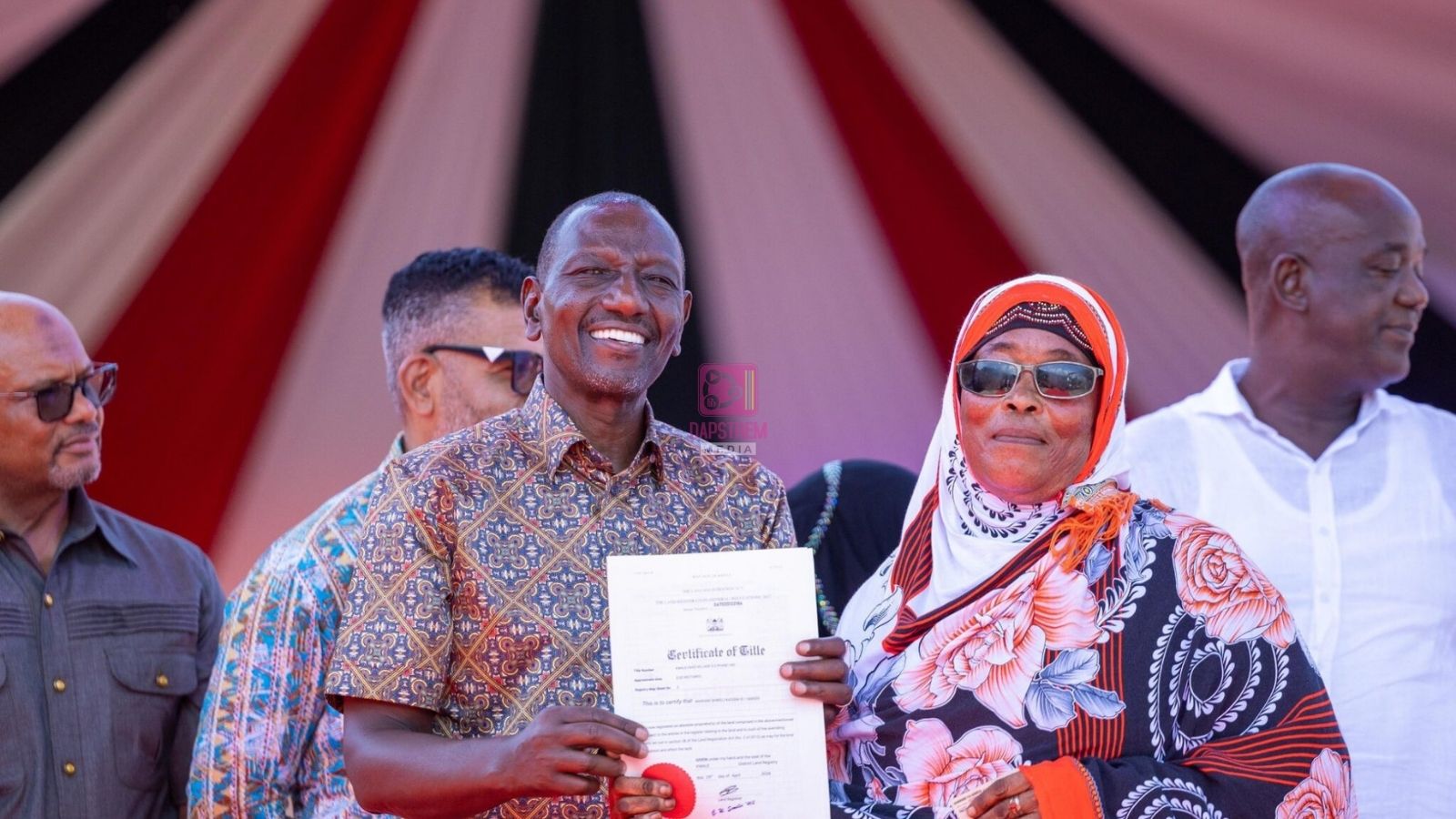
President Ruto Issues 33,000 Title Deeds in Mombasa, Unveils Plan for 200,000 More Across Coast Region
President William Ruto has intensified his administration’s push to resolve the long-standing land ownership crisis at the Coast after issuing 33,000 title deeds in Mombasa and announcing plans to distribute more than 200,000 additional title deeds to residents across the wider Coastal region. The move, which the government is describing as one of the largest land regularisation exercises in recent years, is expected to affect thousands of families who have spent decades living on land without legal ownership documents.
The issuance of the title deeds marks a major milestone in a region where land has historically remained one of the most emotional, politically sensitive, and economically significant issues. For generations, many residents of Coastal Kenya have occupied ancestral land without formal documentation, leaving them vulnerable to eviction, land grabbing disputes, and economic exclusion. The latest government initiative is therefore being framed not just as an administrative process, but as an attempt to address historical injustices that have persisted since the colonial era.
Speaking during the distribution exercise in Mombasa, President Ruto said the government was determined to ensure that residents who have lived on land for years finally receive legal recognition as rightful owners. He described land ownership as a key pillar of economic empowerment, arguing that title deeds would unlock development opportunities, improve access to credit, and provide security for families that have long lived under uncertainty.
The President’s announcement of an additional 200,000 title deeds for Coast residents significantly expands the scope of the programme beyond Mombasa County. The exercise is expected to benefit families in Kilifi, Kwale, Tana River, Lamu, and other parts of the region where unresolved land ownership disputes have remained a persistent challenge for decades.
The Coast land problem has deep historical roots dating back to the colonial period, when vast portions of land were allocated to absentee landlords, Arab settlers, private companies, and politically connected individuals. Indigenous communities that had occupied the land for generations often lacked formal documentation, creating a complex ownership structure that survived even after Kenya gained independence in 1963.
Over the years, successive governments have repeatedly promised to resolve the issue, but progress has been slow due to bureaucratic delays, corruption, overlapping claims, court battles, and politically connected land cartels. Many residents have therefore grown skeptical of official promises regarding land reform, especially after years of stalled adjudication programmes and incomplete settlement schemes.
For thousands of Coast residents, the absence of title deeds has had devastating social and economic consequences. Families without ownership documents have often struggled to build permanent structures, secure bank loans, attract investment, or transfer property legally to future generations. In some cases, communities have lived under constant fear of eviction despite occupying the same land for decades.
The lack of secure land tenure has also contributed to poverty and underdevelopment in parts of the region. Economists have long argued that land ownership documentation is critical for economic growth because it transforms land into a legally recognized asset that can be used for investment and financial leverage. Without title deeds, many residents remain locked out of formal economic systems despite possessing land that could otherwise generate wealth.
President Ruto’s administration appears keen to position the current programme as a turning point in addressing those challenges. Government officials involved in the exercise say the issuance process has involved extensive verification, surveying, adjudication, and registration of land parcels to ensure that ownership records are properly documented before titles are released.
The government has also argued that resolving land ownership disputes could help reduce tensions that have historically emerged around the issue. At the Coast, land grievances have frequently fueled political dissatisfaction and perceptions of marginalisation. In some periods, unresolved land disputes have been linked to unrest, legal conflicts, and growing mistrust toward state institutions.
The title deed programme therefore carries political significance as well. By accelerating land ownership reforms in the region, the government is not only seeking to improve economic conditions but also strengthen public confidence among communities that have long felt excluded from meaningful development.
Residents who received title deeds during the Mombasa event expressed relief after years of uncertainty. For many families, the documents symbolize security and dignity after generations of informal occupation. Some beneficiaries described the moment as life-changing, saying they could now confidently invest in their property without fear of displacement.
Land experts say the programme could significantly transform the economic landscape of the Coast if implemented effectively. With proper ownership documentation, residents may gain easier access to financing from banks and other lending institutions. Small businesses, housing projects, and local investments are also expected to increase once ownership disputes are resolved.
However, despite the optimism surrounding the initiative, experts have cautioned that land reform in Kenya remains highly complex. In many areas, competing ownership claims continue to exist, and some disputes involve multiple families, private companies, or historical beneficiaries. Analysts warn that unless the process is conducted transparently and fairly, new legal battles could emerge in the future.
There are also lingering concerns about corruption within Kenya’s land administration systems. For years, fraudulent title deeds, missing records, illegal allocations, and double registrations have undermined public trust in land registries. Critics argue that long-term reforms will require not only title issuance but also modernization and protection of land records to prevent future manipulation.
Even so, the scale of the current exercise signals a major commitment by the government to confront one of the region’s oldest problems. Issuing 33,000 title deeds in Mombasa alone represents a significant administrative undertaking, while the planned release of over 200,000 more titles across the Coast could reshape ownership patterns in the region for years to come.
Politically, the programme could strengthen President Ruto’s influence in the Coast region, where land rights remain deeply tied to historical identity, economic opportunity, and social justice. Land reform has long been one of the most powerful political issues at the Coast, with leaders frequently judged by their willingness and ability to address historical injustices.
For ordinary residents, however, the issue goes beyond politics. The promise of secure land ownership represents stability for families that have spent decades living in uncertainty. It means the ability to build permanent homes, invest in businesses, educate children using property-backed loans, and pass assets down to future generations without fear of losing them.
As the government prepares to roll out the next phase involving the additional 200,000 title deeds, attention will now shift to implementation. Residents, land rights activists, and legal experts will be watching closely to see whether the programme delivers lasting solutions or becomes another chapter in the Coast region’s long history of unfulfilled land promises.
Still, the ongoing exercise marks one of the most ambitious attempts in recent years to tackle historical land ownership problems in Coastal Kenya. If successfully implemented, it could fundamentally change the economic and social future of thousands of families while reshaping the region’s relationship with land ownership and state institutions for generations to come.