Teun Koopmeiners put the Netherlands ahead with a clever free-kick, Serbia responded through 19-year-old Mihajlo Cvetković, and Joshua Zirkzee restored the Dutch lead in the second half. The victory moved the Netherlands to the top of Group A2 on eight points, level with Greece but ahead on goal difference.
For Xavi Hernández, it was another encouraging result at the beginning of his tenure as Netherlands coach. For Serbia, however, it was another frustrating evening in a Nations League campaign that is rapidly becoming a battle for survival.
A night of experimentation for Xavi
Xavi made one of the most intriguing selection decisions before kick-off, deploying Koopmeiners as a nominal central defender alongside captain Virgil van Dijk.
It was a particularly unusual choice because Koopmeiners is naturally a midfielder. Yet Xavi’s system allowed him to move forward into midfield when the Netherlands had possession, effectively giving the Dutch an extra player in the middle of the pitch.
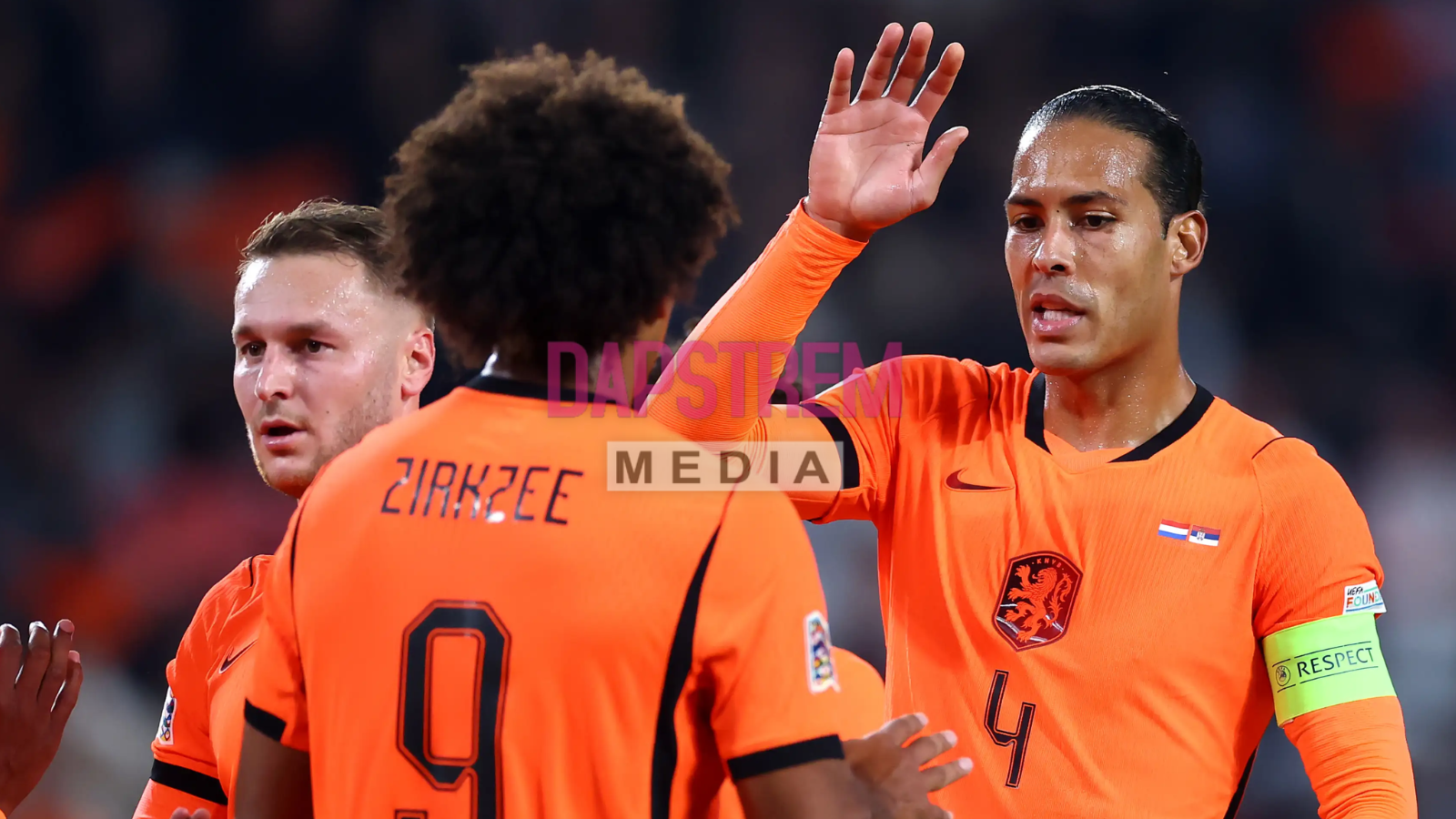
The match also carried enormous personal significance for Van Dijk. The Liverpool defender won his 100th cap for the Netherlands, becoming only the 11th Dutch men’s international to reach that milestone. He captained the side on a memorable evening for one of the most important defenders in the country’s modern history.
Koopmeiners breaks the deadlock
The Netherlands started brightly, with Tijjani Reijnders threatening early and Crysencio Summerville causing problems down the flank.
Serbia goalkeeper Vanja Milinković-Savić was tested during the opening stages, but the breakthrough eventually came from an unexpected source.
In the 31st minute, Koopmeiners stood over a free-kick and produced a delivery that caused enormous confusion in the Serbian defence. The ball travelled across the penalty area without being touched and eventually found the far corner.
The Netherlands were ahead but their advantage lasted only four minutes.
Cvetković gives Serbia a response
Serbia immediately demonstrated why they remained dangerous despite their difficult start to the competition.
Dušan Tadić helped create the opening, with Aleksa Terzić delivering a dangerous cross into the area. Mihajlo Cvetković, only 19 years old, rose to meet it and guided his header beyond Bart Verbruggen.
At 1–1, the momentum shifted. The goal also continued a worrying trend for the Netherlands: they had now conceded in 12 consecutive international matches, something Xavi will undoubtedly want to address as his tenure develops.
Serbia almost completed the turnaround before half-time. Strahinja Pavlović found space behind the Dutch defence but could not find the target.
Zirkzee changes the game
At half-time, Xavi turned to Joshua Zirkzee, replacing Mexx Meerdink.
The substitution would prove decisive. The Netherlands continued to dominate possession but Serbia remained dangerous whenever they were able to break forward. Xavi’s side needed greater efficiency in the final third, and Zirkzee provided precisely that.
In the 72nd minute, Denzel Dumfries sent a low cross into the Serbian penalty area. Reijnders reached the ball and cleverly redirected it toward the far post, where Zirkzee had found space.
The striker made no mistake, finishing from close range to put the Netherlands 2–1 ahead. It was Zirkzee’s second goal for the national team.
The goal was especially important because Serbia had continued to create opportunities. The Netherlands were ahead, but the match was far from settled.
Serbia push for another equaliser
Serbia refused to collapse. Cvetković came close again after getting past Koopmeiners, while other Serbian attacks forced Verbruggen and the Dutch defence into increasingly cautious defending.
The Netherlands’ vulnerability was particularly apparent in the closing stages. Rather than controlling the match comfortably after taking the lead, they were forced to withstand sustained pressure. The biggest scare came in stoppage time.
Nemanja Gudelj struck a powerful effort from distance, only for Verbruggen to produce an excellent save and tip the ball over the crossbar. That save ultimately preserved the three points.
Van de Ven injury creates a bizarre ending
The final minutes produced another complication for Xavi. Micky van de Ven suffered a painful hand injury and had already had the injury taped. With the Netherlands having used all five substitutions, Xavi could not replace him.
Van de Ven was therefore effectively unable to contribute fully as the match entered its final stages, leaving the Netherlands to finish with what was effectively a ten-man side.
What the result means
The victory moves the Netherlands to eight points from four matches and puts them at the top of Group A2.
The situation is remarkably tight, however. Greece also have eight points, while Germany and Serbia remain in contention. Greece’s goalless draw with Germany on the same night allowed the Netherlands to take first place on goal difference.
The Dutch therefore have every reason to be satisfied, but Xavi knows there is plenty to improve. His team can control possession, press intelligently and create chances, yet the defensive record remains concerning. Conceding in 12 successive internationals suggests that the Netherlands’ attacking progress has not yet been matched by defensive stability.
For Serbia, the defeat is more damaging. They have struggled to turn promising passages of play into points, and Sunday’s loss leaves them in a difficult position in Group A2. Yet there were positives: the emergence of Cvetković, the influence of Tadić and the ability to repeatedly threaten the Dutch defence suggest that Serbia are capable of competing with the leading teams. The problem is turning those performances into results.
The bigger story: Xavi is beginning to shape the Netherlands
Perhaps the most significant aspect of the evening was not the scoreline but the evidence of a developing identity.
Xavi has only recently taken charge, yet the Netherlands already show signs of adapting to his ideas: possession, aggressive pressing, positional flexibility and a willingness to change shape during matches.
His decision to use Koopmeiners at centre-back demonstrated that flexibility in its clearest form. It was risky, but it also allowed the midfielder to step into the centre of the pitch and influence possession.
Zirkzee’s winning goal provided another encouraging development. Rather than depending entirely on one established striker, the Netherlands found their match-winner from the bench. And behind them stood Verbruggen, whose late save ensured that Serbia’s pressure did not turn into another Dutch defensive collapse.
Xavi himself said after the match that he was satisfied with the team’s first four games and particularly with their ability to adapt between formations and between periods of possession and defensive organisation. He also acknowledged that the Netherlands must improve defensively.
Final assessment
Netherlands 2–1 Serbia was not a flawless Dutch performance, but it was an important one.
The Netherlands showed character after Serbia equalised, found a decisive goal through Zirkzee and survived a nervous final period thanks in part to Verbruggen.
For Van Dijk, it was a memorable 100th international appearance. For Koopmeiners, it was a night of extremes: an unusual defensive assignment followed by a goal. For Zirkzee, it was the night he came off the bench to decide the match.