
A match overshadowed by Ronaldo
The victory was significant for more than the three points. Coming just days after Cristiano Ronaldo’s dramatic departure from the Portuguese camp, it offered an early indication that Jorge Jesus’s side can remain competitive without their iconic captain. Gonçalo Ramos, the man who started in Ronaldo’s place, ultimately provided the decisive moment.
Portugal entered the game under an unusual amount of scrutiny. Ronaldo had left the squad after reportedly learning that he would not start against Norway, following his earlier absence from the starting XI in the previous meeting with the Norwegians. His departure became one of the dominant storylines surrounding the team.
That made Ramos’s selection particularly noteworthy. Rather than attempting to replace Ronaldo directly, Portugal used a mobile attacking setup in which João Félix and Francisco Conceição could operate around the central striker.
And for much of the first half, Portugal looked the more threatening side.
Norway goalkeeper Egil Selvik had already been called upon before the breakthrough, while Portugal’s attacking players repeatedly found ways into dangerous areas. Yet Norway demonstrated why Erling Haaland and Martin Ødegaard make them such a dangerous opponent.
Ajer produces a moment of brilliance
The opening goal arrived in the 36th minute, and it was one of the game’s outstanding moments.
Martin Ødegaard supplied the ball, and Kristoffer Ajer produced a spectacular finish from the edge of the penalty area, controlling the bouncing ball before sending a dipping effort into the top corner. It was Norway’s reward for staying disciplined despite Portugal having controlled much of the early attacking play.
Portugal’s response, however, was almost immediate.
Just two minutes later, João Cancelo levelled the contest with an equally impressive strike. Nuno Mendes’s long throw kept the move alive, and Cancelo unleashed a fierce effort from outside the area that flew beyond Selvik.
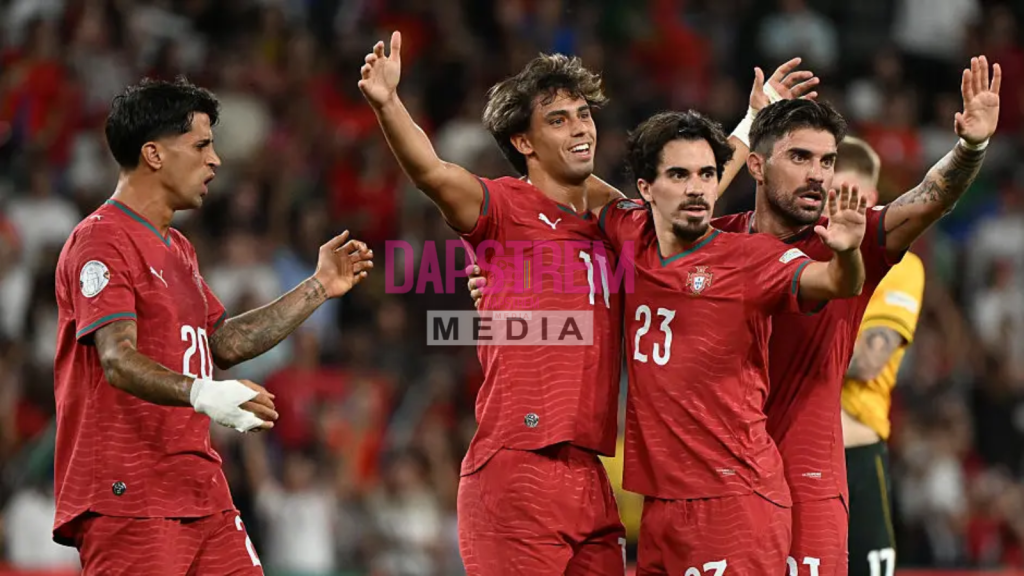 Within the space of two minutes, the game had transformed from a controlled Portuguese performance into a 1–1 contest featuring two spectacular goals.
Portugal’s pressure eventually tells
The second half was more evenly contested.
Norway had opportunities, with Haaland finding space around the Portuguese defence, although the Manchester City striker was unable to make his usual decisive contribution. Around the hour mark he dragged an effort wide from a difficult angle before being substituted in the 67th minute. His departure also raised concerns because he appeared to be struggling physically.
Portugal continued to probe.
Bruno Fernandes tried his luck from distance, Cancelo went close again and Norway’s defence repeatedly had to deal with pressure around the penalty area. The breakthrough finally came in the 79th minute.
João Félix supplied the crucial final pass, cushioning the ball across goal for Ramos, who reacted quickest to poke it over the line from close range. VAR confirmed the goal, and Portugal had completed the comeback.
For Ramos, the goal carried an added significance: he had stepped into the starting position vacated by Ronaldo and delivered the winning goal.
A nervous ending
Portugal should have been able to manage the final stages comfortably, but Francisco Conceição made that task considerably more difficult.
The Porto winger received two yellow cards in quick succession after protesting a penalty decision, resulting in his dismissal in the 86th minute. Portugal therefore had to defend with ten men for the closing stages.
Norway pushed forward, but Portugal survived the late pressure.
The final whistle confirmed a fourth consecutive Nations League victory and, more importantly, guaranteed Portugal a place in the quarter-finals. They moved six points clear of second-placed Denmark in Group A4.
The bigger picture
The result tells an interesting story about the changing identity of Portugal.
For years, virtually every discussion about the national team has revolved around Ronaldo. His absence naturally dominated the build-up to this match, but on the pitch Portugal demonstrated that their attacking threat is no longer dependent upon one player.
Ramos scored. Félix created the winner. Cancelo produced a spectacular equaliser. Bruno Fernandes continued to provide midfield leadership, while the defence held firm when Norway increased the pressure late in the game.
That does not mean Ronaldo’s importance has suddenly disappeared. Portugal’s next challenge will be maintaining this level consistently against stronger opposition and eventually replacing the enormous production and experience accumulated by their all-time leading scorer.
But the early evidence under Jorge Jesus is encouraging.
Portugal have now won all four of their matches in Group A4 and are the first team to qualify for the Nations League quarter-finals. They have also extended their unbeaten home record to 12 matches.
Norway, meanwhile, are moving in the opposite direction. Sunday’s defeat was their third consecutive loss, leaving them bottom of the group with three points after four matches. Their attacking potential remains obvious, particularly with Haaland and Ødegaard, but they have struggled to convert that talent into results.
A victory bigger than the scoreline
Portugal’s 2–1 victory was not their most dominant performance. Jorge Jesus himself acknowledged that the team had not played at the same level as in their previous victory over Denmark, but stressed that qualification was the important outcome. (Reuters)
That may ultimately be the defining characteristic of this Portuguese side.
They fell behind. They lost their biggest star before the match. They conceded a spectacular goal. They then lost a player to a red card with the finish line approaching.
And they still won.
For a team entering a new era, that resilience may prove more important than any individual performance. Gonçalo Ramos’s late winner did more than defeat Norway: it gave Portugal a glimpse of a future in which the team can win important matches even when Cristiano Ronaldo is not there to lead them.