Kivutha Kibwana Takes New Leadership Role as Chancellor of International Leadership University Kenya
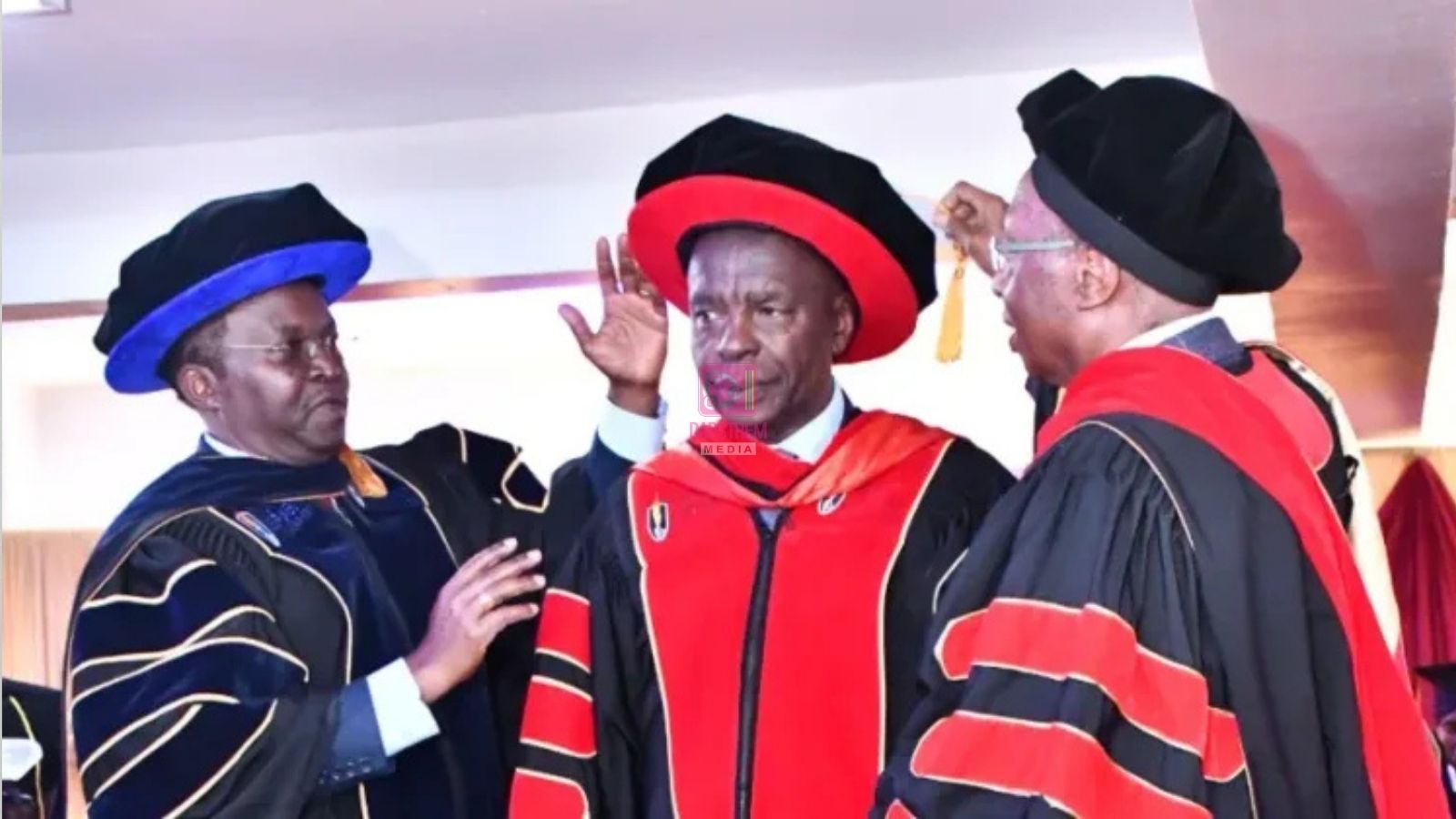
Prof. Kivutha Kibwana has taken on a new leadership role in Kenya’s higher education sector after being installed as the Chancellor of the International Leadership University (ILU), marking another chapter in the long and distinguished career of the former Makueni Governor, lawyer, academic and public servant.
The appointment places Kibwana at the helm of an institution whose mission centres on developing leaders of integrity and equipping them with the knowledge, values and skills needed to contribute to society. ILU describes itself as a university committed to educating Christ-centred, visionary leaders who can drive holistic transformation in Africa and beyond.
For Kibwana, the new position represents a return to an environment with which he has been closely associated throughout much of his professional life. Before becoming a prominent political figure, he established himself as an academic and legal scholar, and his career has consistently combined teaching, law, public service, governance and leadership.
His installation therefore comes at a time when questions about ethical leadership, governance, accountability and the role of universities in shaping society remain important in Kenya.
Kibwana’s academic background makes the chancellorship particularly notable. He studied law at the University of Nairobi and pursued further legal studies at the University of London and George Washington University. He has also been involved in university teaching and has continued to participate in academic discussions even after leaving elective politics. Recent profiles of Kibwana have highlighted his long-standing connection with academia and his experience as a law professor.
His journey into public leadership did not erase his identity as an academic.
Instead, his experiences in politics and government added another dimension to his understanding of leadership, institutions and public administration.
Kibwana served as the first Governor of Makueni County, holding office from 2013 to 2022. Before becoming governor, he was a Member of Parliament and served in the national government in ministerial positions. His career has also included work in human rights, constitutionalism and governance. The Council of Governors lists him among Kenya’s former governors, while recent profiles have described his career as spanning academia, law, government and county leadership.
His experience in different areas of public life could give him a broad perspective as he takes up the new university role.
A chancellor’s position in a university is not simply ceremonial. While the day-to-day academic and administrative affairs of a university are generally handled by the vice-chancellor and management, the chancellor plays an important role in providing leadership, representing the institution and supporting its broader vision.
For an institution focused specifically on leadership development, the appointment of someone with Kibwana’s background carries particular significance.
ILU has built its identity around the idea that education should go beyond academic qualifications. The university’s stated mission is to develop leaders who combine knowledge with character and who can contribute to transformation in their communities.
That philosophy is likely to be an important part of Kibwana’s tenure.
Kenya has no shortage of university graduates, professionals and people holding academic qualifications. Yet the country continues to debate the quality of leadership in politics, business, government, civil society and other institutions.
This creates a space for universities to play a much larger role in preparing people not only to find employment but also to become responsible decision-makers.
Leadership education can help students understand that leadership is about more than occupying an influential position.
It involves accountability, ethical decision-making, service, responsibility and the ability to understand the consequences of one’s actions.
These are issues Kibwana has repeatedly addressed throughout his career.
During his time in public life, he became particularly associated with discussions on governance, constitutionalism and development. Even after leaving the Makueni governorship, he has continued to speak publicly about the direction of Kenyan politics and leadership.
Earlier this month, for example, Kibwana warned that Kenya could risk a repeat of the 2007 post-election violence if political leaders continued to prioritise the pursuit of power over the needs of citizens. He argued that political competition should not overshadow development and public service.
Those views provide an indication of the kind of leadership philosophy he could bring into his new academic role.
His appointment also comes at an important period for ILU itself.
The university has been expanding its academic programmes and infrastructure while continuing to position itself as an institution focused on leadership, theology, social sciences, counselling and related disciplines. Its current programmes include certificate, diploma, undergraduate, master’s and PhD courses.
The university has also been expanding its physical presence.
ILU’s Kitengela campus, which the institution describes as the “Seat of the University”, is part of its long-term expansion. The university acquired 50 acres in Kitengela in 2007, while construction of the campus began following a groundbreaking ceremony in December 2021. The facility now hosts the School of Education and Social Sciences.
That expansion means the university is operating in an environment where strong institutional leadership will be increasingly important.
As universities grow, they must balance academic quality, financial sustainability, student welfare, research, infrastructure development and their wider contribution to society.
The chancellor can help provide strategic guidance while representing the institution’s values to the wider public.
Kibwana’s experience in both academia and government could prove useful in this regard.
His relationship with ILU is also not entirely new.
In 2021, while serving as Makueni Governor, Kibwana presided over the university’s 36th graduation ceremony. During that event, he spoke about the importance of developing leaders with enduring values who could contribute to inclusive wellbeing and sustainable development. ILU at the time was celebrating four decades of developing leaders of integrity.
That earlier association makes his appointment particularly interesting.
It suggests that the institution and Kibwana have had a relationship built around shared ideas about leadership and education.
The university has also undergone considerable development since those earlier years.
ILU was formerly known as the Nairobi International School of Theology and admitted its first students in 1981. Over the years, it expanded beyond its original focus and developed programmes in areas including leadership and governance, education and social sciences, theology and Christian ministry, and counselling psychology.
Its growth reflects a broader change in the higher education sector, where institutions are increasingly expected to prepare students for complex professional and social environments.
For ILU, however, leadership remains at the heart of its identity.
The university’s stated values include integrity, moral uprightness, stewardship, accountability, excellence and transformation.
These values could become even more significant under Kibwana’s leadership.
One of the major challenges facing higher education in Kenya is the gap between academic achievement and practical leadership.
A student may graduate with excellent grades but still struggle when confronted with ethical dilemmas, organisational challenges or responsibilities involving public resources.
Universities therefore have an opportunity to develop both competence and character.
This is particularly important in professional fields such as law, governance, business, education and social sciences.
Kibwana’s own career illustrates the intersection between these disciplines.
As a lawyer and academic, he developed expertise in law and governance.
As a politician and governor, he encountered the practical realities of administering public institutions.
As a public intellectual, he has continued to participate in debates about Kenya’s political and social direction.
His experience gives him an unusual understanding of the difference between leadership theory and leadership in practice.
That could become an important asset to ILU students.
Young people entering universities today are preparing for a world that is very different from the one Kibwana entered as a young academic.
Technology has transformed communication and employment.
Artificial intelligence is changing workplaces.
Social media has transformed political communication and public debate.
Businesses operate in increasingly global environments.
At the same time, societies continue to deal with corruption, inequality, unemployment, political polarisation and questions about ethics.
Universities therefore have to prepare students to navigate not only professional careers but also rapidly changing social environments.
Leadership education must evolve accordingly.
It must teach students how to think critically, communicate effectively, work with people from different backgrounds and make decisions responsibly.
It must also encourage them to understand that leadership is ultimately about service.
This is particularly relevant to ILU’s Christian identity.
The university’s mission places emphasis on developing Christ-like and visionary leaders who can contribute to holistic transformation.
Under Kibwana, that mission will potentially receive a strong connection to Kenya’s broader conversations about ethical public leadership.
His political career has given him first-hand experience of the pressures and challenges that leaders face.
That experience could help him encourage students to approach leadership with realism rather than idealism alone.
Leadership is not simply about making decisions when everything is going well.
It is also about making difficult choices during periods of crisis, managing competing interests, accepting criticism and remaining accountable.
Kibwana’s years in government and county administration exposed him to many of these realities.
His tenure as Makueni governor also became associated with discussions around governance and development, contributing to his reputation as a leader who placed considerable emphasis on institutional performance and accountability.
The new role could therefore provide him with another platform to influence the next generation of leaders without necessarily being directly involved in electoral politics.
This is an important shift.
After leaving the Makueni governorship in 2022, Kibwana has remained active in public discussions. In recent months, he has continued commenting on Kenya’s political environment and has spoken about the importance of productive politics and responsible leadership.
The university environment offers a different avenue for that influence.
Instead of seeking to shape policy directly through government, he can contribute to shaping the people who will eventually occupy positions of responsibility across government, business, academia, civil society and other sectors.
That could arguably be one of the most lasting forms of leadership.
A politician may serve for a limited period.
A teacher or academic can influence generations.
A university that successfully develops ethical leaders can have an impact that extends far beyond its campus.
That is the opportunity before Kibwana and ILU.
The institution will also be expected to continue strengthening academic quality.
As competition increases among universities in Kenya and across Africa, institutions have to demonstrate that their graduates possess qualifications that are relevant to changing labour markets.
ILU’s current focus on leadership, theology, counselling, business and social sciences provides a range of opportunities for students seeking careers in both traditional and emerging fields. The university is currently advertising certificate, diploma, undergraduate, master’s and PhD programmes and an August 2026 intake.
Research will also remain important.
Universities cannot simply teach what is already known. They must contribute new knowledge and help society understand emerging challenges.
For an institution focused on leadership, this could mean expanding research into governance, ethics, public administration, organisational leadership, social transformation and related areas.
Kibwana’s legal and academic background could contribute significantly to such conversations.
His appointment may also strengthen the university’s public profile.
Having a former governor, cabinet minister, lawyer and professor at the top of an institution can attract attention from students, academics, policymakers and development partners.
It could also create opportunities for partnerships between the university and other institutions.
However, the success of his tenure will ultimately depend on more than his reputation.
The institution will still need strong academic leadership, competent management, adequate resources and a clear strategic direction.
The vice-chancellor and university management will continue to play the central role in the day-to-day running of the institution.
The chancellor’s contribution will be most valuable when it complements rather than replaces those structures.
There will also be expectations that Kibwana will use his position to champion integrity.
Kenya’s leadership challenges have often been discussed in relation to corruption, misuse of public resources, political patronage and weak accountability.
An institution that explicitly describes itself as developing leaders of integrity has an opportunity to address these issues directly through education.
Students can be taught that success should not be measured purely by wealth or position.
Leadership should also be measured by the impact an individual has on other people and institutions.
That philosophy is consistent with ideas Kibwana has expressed over the years.
In 2021, while speaking at ILU’s graduation, he argued that knowledge without values is futile and praised the university for training leaders around stewardship, societal transformation and enduring values.
Those remarks now carry additional significance following his installation as chancellor.
The challenge will be turning those principles into a lasting institutional culture.
For students, the appointment could provide an opportunity to learn from someone who has experienced leadership in classrooms, government offices and county administration.
For faculty members, it could bring an experienced academic and public leader into the institution’s strategic conversations.
For the university itself, it could strengthen its identity as a place where leadership education is connected to real-world experience.
And for Kenya’s higher education sector, the appointment adds another example of how experienced public figures can continue contributing to society through academic institutions after leaving elective office.
Kibwana’s transition from governor to chancellor also reflects a broader reality about leadership careers.
Public service does not necessarily end when an elected position ends.
People with experience in government can continue contributing through education, research, mentorship, policy discussions and community development.
In Kibwana’s case, his academic career predates his political career, making the transition particularly natural.
He has previously described himself as a teacher and has spoken about beginning university teaching at a young age. Reports have noted that he taught for many years before moving deeper into public service.
His return to a senior academic leadership role can therefore be viewed as another stage in a career that has repeatedly moved between the classroom and public service.
As he takes up the chancellorship, attention will likely focus on how his experience can help ILU strengthen its mission and expand its influence.
The university’s ambition to develop leaders who can contribute to Africa and the wider world requires more than academic programmes.
It requires mentorship, institutional integrity, research, innovation and strong connections with society.
Kibwana’s experience gives him an opportunity to contribute to all of these areas.
At the same time, his appointment comes with significant expectations.
Students will expect an institution that gives them relevant skills.
Faculty will expect strong institutional support.
Parents will expect quality education.
Employers will expect graduates who can perform professionally.
And society will expect universities to produce people capable of addressing the challenges facing Kenya and Africa.
Those expectations make the chancellorship an important responsibility.
For Kibwana, the new role offers an opportunity to influence public life in a different way.
He has already served in Parliament, government and county leadership.
He has participated in national political debates and contributed to Kenya’s constitutional and governance conversations.
Now, through the university, he has an opportunity to invest in the people who will shape the country’s future.
That may ultimately become one of the most significant chapters of his public career.
The installation of Prof. Kivutha Kibwana as Chancellor of the International Leadership University therefore represents more than a change in university leadership.
It brings together two worlds that have defined much of his life: academia and public service.
It also places an experienced lawyer, professor and former governor at an institution whose central mission is to develop leaders of integrity.
The partnership between Kibwana and ILU will now be watched closely as the university continues expanding its academic programmes, infrastructure and leadership-development agenda.
For a country that continues to debate the quality and character of its leaders, the timing could hardly be more relevant.
If universities succeed in producing leaders who combine knowledge with integrity, competence with compassion and authority with accountability, they can help shape a very different future for Kenya.
And for Kibwana, the new position offers another opportunity to do what has defined much of his career — teach, lead, challenge conventional thinking and contribute to the development of the next generation.
His installation marks the beginning of that new chapter, with the International Leadership University placing its leadership-development mission under the guidance of a man whose own journey has taken him from the university classroom to the highest levels of county and national public service, and now back to higher education.