
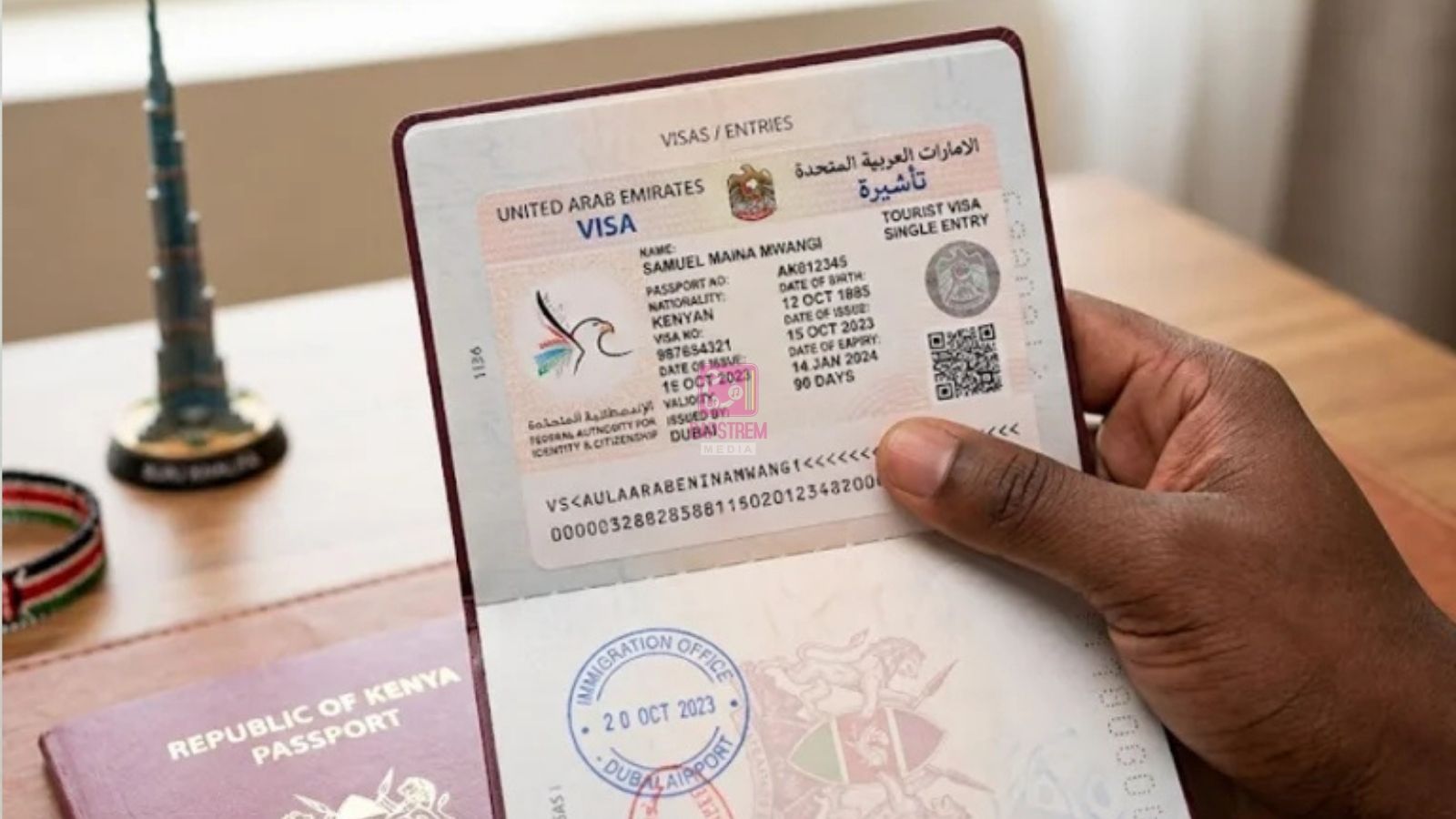
UAE Eases Travel for Eligible Kenyans With Valid US, UK and EU Permits Through Visa-on-Arrival Access
The United Arab Emirates (UAE) has introduced a new visa-on-arrival arrangement that could make travel significantly easier for eligible Kenyan passport holders who already possess valid visas or residence permits from certain Western countries.
Under the new arrangement, Kenyan citizens holding valid visas or residence permits issued by the United States, the United Kingdom or a European Union member state may qualify to obtain a UAE visa on arrival, reducing the need to complete the traditional visa application process before travelling.
The development is expected to be welcomed by Kenyan travellers, particularly businesspeople, tourists, students, professionals and families who regularly travel between Kenya and the UAE.
The UAE is one of the most important travel and business destinations for Kenyans. Dubai and Abu Dhabi, in particular, attract large numbers of visitors from Kenya every year for tourism, trade, employment-related travel, shopping, conferences and other activities.
The introduction of the new arrangement could therefore simplify the travel process for a section of Kenyan travellers and make the UAE more accessible to people who already hold valid travel documents from recognised Western jurisdictions.
The new policy is also part of a broader effort by the UAE to facilitate international travel and attract visitors from different parts of the world. By recognising certain valid US, UK and EU visas or residence permits, the UAE is effectively using existing travel-screening arrangements to facilitate entry for eligible travellers.
For Kenyan passport holders, however, the key word is eligible.
Not every Kenyan travelling to the UAE will automatically qualify for visa on arrival. The arrangement applies to travellers who meet the specific conditions set by UAE authorities, including holding qualifying valid documentation from the United States, United Kingdom or European Union.
Travellers should therefore carefully verify the requirements before making travel arrangements rather than assuming that possession of a Kenyan passport alone is sufficient.
The new arrangement could be particularly significant for Kenyans who frequently travel internationally.
A Kenyan professional holding a valid US visa, for example, may now have an easier route to enter the UAE without having to go through a separate visa application process for every short visit, provided all the UAE’s conditions are met.
The same could apply to Kenyan travellers holding qualifying UK or EU documentation.
This could make spontaneous business trips, short holidays and transit-related travel more convenient.
For business travellers, time is often one of the most important considerations when planning international trips.
A traditional visa application can involve preparing documents, submitting an application, waiting for processing and dealing with additional requirements.
A visa-on-arrival arrangement can reduce some of these administrative steps and give eligible travellers greater flexibility.
This could benefit Kenyan entrepreneurs who frequently travel to Dubai to source products, attend exhibitions, meet suppliers or explore investment opportunities.
Dubai has established itself as a major international commercial hub, connecting businesses from Africa, Asia, Europe and the Middle East.
Kenyan traders and entrepreneurs have long used the UAE as a gateway for international commerce.
Simplifying travel could therefore strengthen existing commercial ties between the two countries.
The tourism sector could also benefit.
The UAE, particularly Dubai, has become a popular destination for Kenyan tourists seeking luxury shopping, entertainment, beaches, cultural attractions and international events.
For travellers who already hold qualifying US, UK or EU visas or residence permits, the new arrangement could make it easier to add the UAE to their travel plans.
For example, a Kenyan traveller visiting Europe could potentially include the UAE in a wider international itinerary, subject to meeting the applicable entry requirements.
Families may also benefit from the policy.
Kenyans living, working or studying in the United States, United Kingdom or European Union frequently travel internationally for holidays and family visits.
The ability to enter the UAE more easily could provide an additional travel option for such individuals.
However, travellers should not confuse a visa issued by another country with permission to enter the UAE.
The US, UK or EU document is essentially part of the eligibility criteria for the UAE’s visa-on-arrival facility. It does not replace UAE immigration requirements.
Travellers must still satisfy UAE border authorities and provide the required documents.
This is an important distinction because immigration policies can have several conditions attached to them.
Applicants may need a passport with sufficient validity, a qualifying visa or residence permit and other supporting documentation.
Airlines may also verify travel documents before allowing passengers to board.
For this reason, eligible Kenyan travellers should confirm the latest requirements with UAE immigration authorities or their airline before travelling.
The policy could also encourage more Kenyans to consider the UAE as part of their international travel plans.
For people who already hold US, UK or EU visas, the new arrangement effectively opens another destination without requiring them to go through an entirely separate visa process in advance.
That could be particularly attractive to frequent travellers.
It may also encourage more business exchanges between Kenya and the UAE.
Kenya and the UAE have developed strong economic and diplomatic relations over the years, with cooperation spanning trade, investment, tourism, aviation and other sectors.
Dubai has also become an important hub for Kenyan exporters and importers.
Kenyan agricultural products, including fresh produce, have markets in the Gulf region, while Kenyan businesses import a wide range of goods through UAE-based suppliers and trading companies.
Easier movement of people can support these economic relationships.
Business relationships are often strengthened through face-to-face meetings, conferences, exhibitions and negotiations.
When travel is easier, entrepreneurs may be more willing to explore new markets and establish partnerships.
The arrangement could therefore have implications beyond tourism.
It could support trade and investment by making it easier for eligible Kenyan businesspeople to travel to the UAE for short-term engagements.
The aviation sector could also benefit indirectly.
Kenya and the UAE are connected by regular flights, with Dubai serving as a major international transit point for travellers from Nairobi and other parts of the region.
A more convenient entry regime could contribute to increased passenger traffic if more eligible travellers choose to visit the UAE.

For Kenyan travellers, the development also highlights the growing importance of maintaining valid international travel documents.
A traveller who already has a valid US, UK or EU visa or residence permit could now have additional travel opportunities because of the UAE arrangement.
This may make such documents even more valuable for frequent international travellers.
However, travellers should be careful about the validity and type of document they hold.
Not every permit or visa necessarily qualifies.
The specific terms of the UAE policy determine which documents are accepted, their validity requirements and the conditions attached to entry.
It is therefore important for travellers to check the official requirements before purchasing a ticket.
This is particularly important because airline staff may deny boarding if a traveller cannot demonstrate that they meet the entry requirements.
A misunderstanding of the policy could result in unnecessary expenses, including missed flights, accommodation costs and other travel disruptions.
The new arrangement should therefore be viewed as an opportunity accompanied by a responsibility to verify the rules.
For travel agencies in Kenya, the development could also create new opportunities.
Travel consultants may experience increased demand from clients seeking to understand the new visa-on-arrival arrangements and determine whether they qualify.
Agencies will need to provide accurate information and avoid promising entry to travellers who do not meet the conditions.
The policy could also increase interest in UAE holiday packages among Kenyans.
Dubai’s attractions, including its shopping malls, skyscrapers, theme parks, beaches and entertainment facilities, already make it a popular destination.
A simpler visa process could make short trips more appealing, particularly for travellers who may have previously been discouraged by visa requirements.
The development comes at a time when countries around the world are increasingly looking at ways to simplify international travel while maintaining immigration controls.
Visa-on-arrival arrangements can help governments attract tourists and business visitors without completely eliminating border screening.
Travellers still pass through immigration controls when they arrive.
This means the UAE retains the ability to assess passengers at the point of entry.
The arrangement can therefore be seen as a balance between facilitating travel and maintaining immigration oversight.
For Kenya, the development could also encourage discussions about reciprocal or expanded travel arrangements with other countries.
Visa policies play an important role in international relations.
When countries simplify travel requirements for each other’s citizens, they can encourage tourism, business, education and cultural exchanges.
Kenyans have increasingly become international travellers, with growing interest in destinations across Africa, the Middle East, Europe, Asia and North America.
Travel accessibility can therefore have a direct impact on tourism and business opportunities.
At the individual level, the UAE announcement could save eligible travellers time and reduce some of the uncertainty associated with advance visa applications.
However, travellers should remember that visa-on-arrival does not necessarily mean visa-free entry.
There may still be fees, immigration procedures and conditions attached to the visa issued upon arrival.
The length of stay permitted under the facility is also an important factor.
Travellers should confirm exactly how long they are allowed to remain in the UAE and whether the visa can be extended.
Overstaying immigration permission can result in fines or other legal consequences.
It is therefore important for visitors to understand the conditions of their stay from the moment they arrive.
Another important consideration is the purpose of travel.
A visa-on-arrival facility for visitors does not automatically authorise employment or other activities requiring a different immigration status.
Kenyans travelling for tourism or business meetings should ensure that their activities are consistent with the permission granted to them.
Those intending to work, study or relocate to the UAE would need to follow the appropriate visa and residency procedures.
This distinction is particularly important because the UAE is home to a large Kenyan community, including professionals and workers in different sectors.
The new arrangement is primarily relevant to eligible visitors and should not be interpreted as a new work-permit system.
For Kenyan workers already living in the UAE, the policy may have limited direct impact on their residency status.
Its biggest effect is likely to be felt by Kenyan passport holders travelling to the UAE for short visits.
The development could also benefit Kenyans using the UAE as part of wider international travel.
Dubai’s position as a global aviation hub means that travellers frequently pass through its airports while connecting between Africa, Europe, Asia and other regions.
For eligible passengers who wish to leave the airport and spend time in the UAE during their trip, the new arrangement could potentially provide greater flexibility, subject to the applicable immigration rules.
This could encourage more travellers to extend their stopovers into short visits.
For Kenyan tourists, the timing is also significant because international travel has become increasingly popular among middle-class families, young professionals and entrepreneurs.
Social media has contributed to the popularity of destinations such as Dubai, with travellers sharing experiences of hotels, shopping, restaurants, attractions and desert excursions.
Simplified visa arrangements can make such destinations more accessible.
However, travellers should continue to budget carefully.
A simpler visa process does not necessarily mean that a UAE holiday will be inexpensive.
Accommodation, flights, food, transportation, insurance and entertainment can still represent a significant expense.
Travellers should therefore distinguish between the cost of obtaining entry permission and the overall cost of travelling.
For businesspeople, the calculation may be different.
A short trip to Dubai can potentially create opportunities for partnerships, supplier negotiations and market research.
Reduced administrative barriers may make such trips easier to organise, particularly for entrepreneurs who already hold qualifying international visas or permits.
The new policy could consequently contribute to greater movement between Kenya and the UAE.
The wider impact will depend on how many Kenyan passport holders meet the eligibility requirements and choose to take advantage of the arrangement.
It will also depend on how effectively travel agencies, airlines and government institutions communicate the rules.
Clear information will be essential.
Immigration policies can change, and conditions may be updated by authorities.
Travellers should therefore rely on official UAE government and airline information when preparing for their journeys.
They should also ensure that their passports and supporting documents are valid and available in the required form.
For now, the introduction of visa-on-arrival access for eligible Kenyan travellers represents a positive development for Kenya-UAE travel relations.
It could reduce administrative hurdles, encourage tourism, support business travel and provide greater flexibility to Kenyans who already possess qualifying US, UK or EU visas or residence permits.
The policy also reinforces the UAE’s position as a major global destination that is seeking to make international travel more convenient for selected categories of visitors.
For Kenyan travellers, the most important takeaway is that the opportunity comes with conditions.
Holding a Kenyan passport does not by itself guarantee visa-on-arrival entry.
Travellers must meet the UAE’s eligibility requirements and should confirm the latest rules before departure.
Those who qualify, however, could find it significantly easier to make short trips to the UAE for tourism, business, family visits and other permitted purposes.
As Kenya and the UAE continue strengthening their economic and people-to-people ties, easier travel could become an increasingly important part of that relationship.
The new visa-on-arrival arrangement is therefore more than a change to immigration procedures.
It represents another step towards facilitating movement between two countries with growing commercial, tourism and social connections.
For eligible Kenyans, it could mean fewer administrative hurdles and more freedom to explore one of the world’s most popular international destinations.