
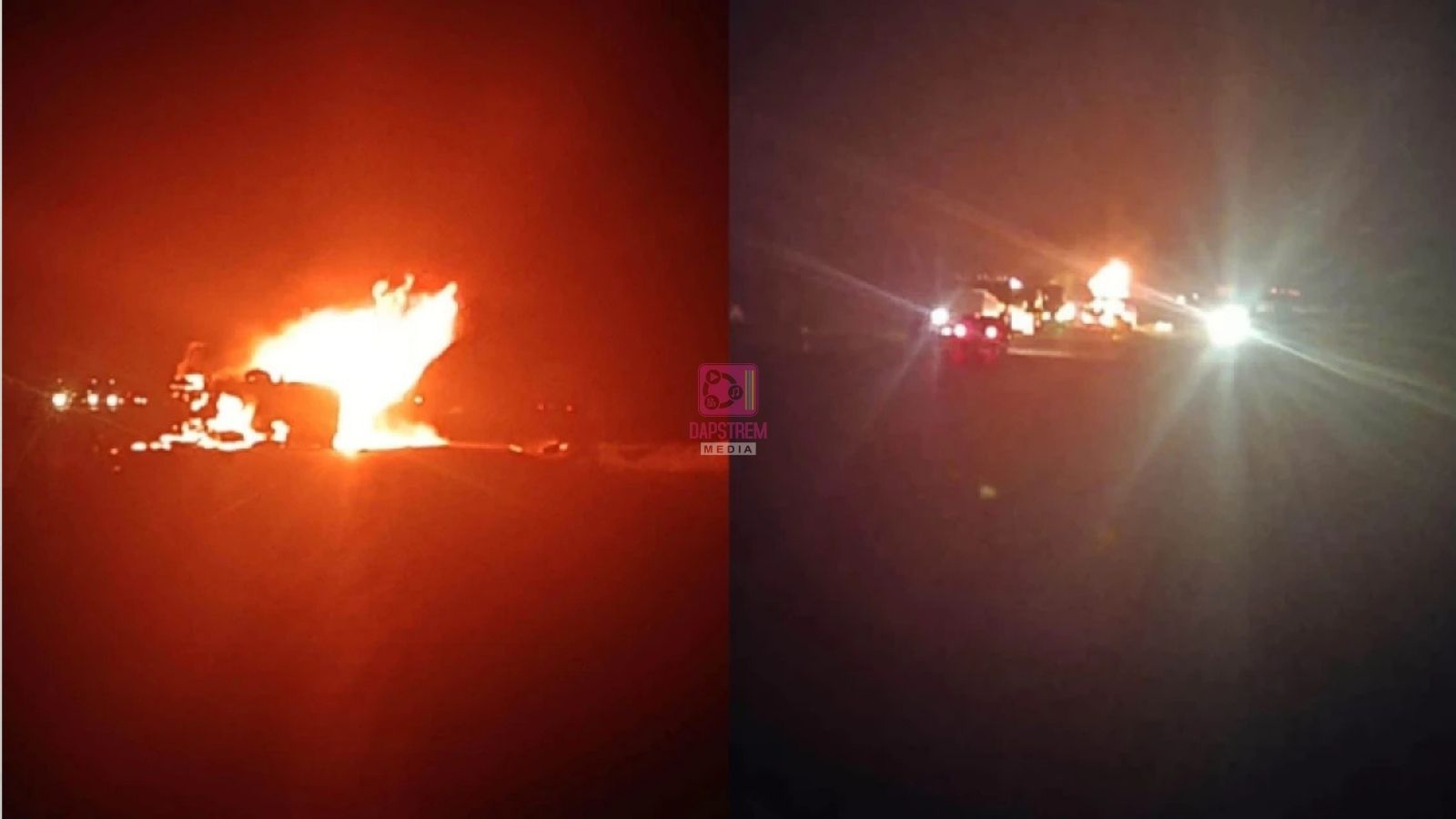
Two People Killed, 14 Injured After Fuel Tanker Explodes Near Paul Boit High School in Turbo
Two people have been confirmed dead and 14 others injured after a fuel tanker exploded near Paul Boit High School along the Eldoret-Webuye highway in Turbo, Uasin Gishu County.
The incident happened on Thursday night, September 17, 2026, turning a busy section of the highway into a scene of panic, flames and an emergency rescue operation.
The tanker had overturned along the highway before the fire broke out. Initial reports indicated that several members of the public had gathered around the damaged tanker after fuel began spilling from it.
Some of those at the scene were reportedly attempting to collect the leaking fuel when the tanker caught fire and exploded.
The resulting blaze injured several people and claimed the lives of two others.
The incident prompted a major emergency response involving the Kenya Red Cross, police officers, firefighters and ambulance teams, as authorities worked through the night to rescue victims and secure the area.
The Kenya Red Cross described the incident as a mass-casualty event and confirmed that its teams were deployed to the scene alongside the Kenya Police and firefighters.
Motorists were also urged to keep away from the affected section of the highway to allow emergency responders to reach the scene and evacuate victims without obstruction.
The tragedy has once again highlighted the dangers associated with approaching overturned fuel tankers, particularly when fuel is leaking from the vehicle.
According to police, the tanker was travelling from Eldoret when it lost control and overturned after colliding with another vehicle travelling from the Webuye direction. The accident occurred at around 8:20 p.m., according to Uasin Gishu County Police Commander Wilberforce Sicharani.
What happened in the minutes that followed is now the subject of investigations.
Reports from the scene indicate that residents moved towards the tanker after the crash and attempted to siphon fuel.
The situation changed dramatically when the tanker caught fire.
The flames quickly spread around the accident scene, exposing people nearby to intense heat and resulting in severe burn injuries.
The two people who died have been confirmed by police, while injured victims were taken to different health facilities for treatment.
Moi Teaching and Referral Hospital in Eldoret received some of the injured victims.
The exact condition of all those injured was not immediately available, although reports indicated that some suffered serious burns and required specialised medical attention.
The casualty figures also developed as emergency teams continued assessing the scene.
An initial Kenya Red Cross alert issued late Thursday night did not immediately provide a confirmed number of deaths or injuries.
By Friday morning, however, authorities had confirmed two fatalities, while different reports put the number of injured victims at between 14 and 22 as hospitals and emergency agencies continued accounting for those affected.
This means that the casualty situation may continue to be clarified as authorities complete their assessment and hospitals account for patients.
Police have continued examining the area to establish whether there could be additional victims and to piece together the exact sequence of events.
The danger of approaching overturned tankers
The latest tragedy has revived concerns over a dangerous practice that has been witnessed in different parts of Kenya following accidents involving fuel tankers.
When a tanker carrying petrol or another highly flammable product overturns, members of the public sometimes rush to the scene hoping to collect leaking fuel.
What may appear to some people as an opportunity to obtain free fuel can quickly become a life-threatening situation.
Fuel vapour can ignite even when there is no obvious flame nearby.
A spark from a vehicle, electrical equipment, a cigarette, friction or another ignition source can potentially trigger a fire.
In the Turbo incident, people who had gathered around the tanker were caught in the ensuing blaze.
Police have again warned members of the public against approaching overturned tankers or attempting to siphon fuel from them. (KBC)
The warning is particularly important because people at an accident scene may not immediately realise how dangerous the situation has become.
An overturned tanker may continue leaking fuel for several minutes before a fire starts.
That period can create a false sense of safety.
People may see others approaching the vehicle without anything happening and conclude that it is safe to do the same.
However, the presence of leaking fuel means the danger can increase rapidly.
Fuel vapour can spread beyond the immediate location of the tanker, potentially placing people who are some distance away at risk.
For that reason, emergency responders routinely urge members of the public to keep a safe distance from vehicles involved in fuel-related accidents.
The Turbo incident has once again demonstrated why such warnings are important.
Emergency teams respond
The Kenya Red Cross was among the organisations involved in the emergency response.
The organisation activated its response teams after the explosion and worked alongside police and firefighters at the scene.
County ambulance services and members of the public also helped evacuate victims to hospitals.
Some of the seriously injured were taken to Moi Teaching and Referral Hospital, where they could receive specialised treatment for burn injuries.
Firefighters worked to contain the flames while police officers secured the area and helped manage the situation.
The response was complicated by the location of the accident along one of the important transport corridors in western Kenya.
The Eldoret-Webuye highway carries significant traffic, including passenger vehicles, private cars and heavy commercial trucks.
An accident involving a fuel tanker can therefore affect not only people at the scene but also hundreds of motorists travelling along the road.
Motorists were advised to avoid the affected area while emergency personnel carried out rescue operations.
Traffic was disrupted as authorities worked to contain the situation and clear the highway.
According to reports, the fire was eventually contained and traffic flow was restored after the emergency operation.
Police begin investigations
Police have launched investigations into the circumstances surrounding the crash and subsequent explosion.
The first question investigators will need to answer is what caused the tanker to overturn.
Police have said the tanker was involved in a collision with another vehicle before overturning.
Investigators will also examine what happened after the crash.
One of the key issues will be determining how the fire started and whether any actions at the scene contributed to the explosion.
Uasin Gishu County Police Commander Wilberforce Sicharani said preliminary investigations were continuing.
According to The Standard, police were examining a preliminary possibility that the fire may have been triggered when someone attempted to remove the tanker’s battery. The investigation had not been concluded, and authorities were still working to establish the exact cause. (The Standard)
This distinction is important because the exact cause of the fire remains subject to investigation.
Early accounts from witnesses and people at the scene can help investigators reconstruct what happened, but the final explanation will depend on evidence collected from the tanker, the road and surrounding area.
Investigators may also examine the condition of the tanker, the vehicles involved in the collision, road conditions and statements from witnesses.
The findings could help authorities establish whether the crash resulted from mechanical failure, driver error, road conditions, the collision itself or another factor.
Families face a painful wait
Behind the casualty figures are families now dealing with the consequences of the tragedy.
For the families of the two people who died, the accident has created sudden loss.
The situation is particularly difficult when victims are killed in circumstances that unfold within minutes.
For families of the injured, attention has shifted to treatment and recovery.
Severe burns can require specialised medical care and prolonged treatment.
Some victims may need surgery, repeated medical procedures and rehabilitation depending on the severity of their injuries.
The financial impact can also be significant for families whose relatives require extended hospitalisation.
As hospitals continue treating the injured, relatives and friends are expected to gather around the affected families to provide support during the difficult period.
Authorities will also need to ensure that families receive accurate information about the victims and that the identification process is handled properly.
A reminder about road safety
The accident also raises broader questions about road safety along the Eldoret-Webuye highway.
The route is an important transport corridor used by heavy trucks moving between different parts of the country.
Fuel tankers are among the vehicles that regularly use major highways to transport petroleum products.
An accident involving such a vehicle can have consequences far beyond the people directly involved in the initial collision.
This is because the cargo itself can become a major hazard.
The Turbo explosion demonstrates the importance of strict safety measures for vehicles transporting petroleum products.
Drivers of tankers have a major responsibility to maintain control of their vehicles and follow traffic regulations.
Transport companies also have a responsibility to ensure that vehicles are properly maintained and that drivers are adequately trained.
Authorities, meanwhile, have a responsibility to enforce road safety requirements and respond quickly when dangerous incidents occur.
But members of the public also have an important role to play.
Approaching an overturned fuel tanker is extremely dangerous, regardless of whether fuel appears to be leaking or not.
People who arrive at such scenes should instead alert emergency services, keep away from the vehicle and help prevent others from moving into the danger zone.
The temptation to collect spilled fuel can have devastating consequences, as the latest incident has shown.
The wider concern over fuel tanker accidents
The Turbo tragedy is also likely to renew calls for stronger public awareness campaigns following tanker crashes.
Fuel tanker accidents have repeatedly demonstrated how quickly a road accident can turn into a mass-casualty incident.
A tanker can overturn following a collision, mechanical problem or loss of control.
Once the container is damaged, fuel can spill across the road and surrounding areas.
If people then gather around the vehicle, the number of people exposed to danger can increase dramatically.
The situation becomes even more complicated at night, when visibility is poor and people may have difficulty recognising hazards.
The accident near Paul Boit High School happened at night, adding another challenge for responders.
Emergency teams had to operate around a burning tanker while dealing with victims, traffic and a potentially dangerous environment.
Such situations require coordination between police, firefighters, medical teams and humanitarian organisations.
The response in Turbo involved several of these agencies working together.
The Kenya Red Cross confirmed that it was coordinating with police and firefighters as the emergency unfolded. (Citizen Digital)
Authorities continue assessing the scene
As of Friday, police were still working to establish the full circumstances surrounding the accident.
The authorities also continued checking the surrounding area to determine whether there were other casualties.
This assessment is important because the initial chaos following a major explosion can make it difficult to immediately establish the exact number of people involved.
Some injured people may leave the scene with the assistance of relatives or members of the public before being formally recorded by emergency agencies.
Others may be taken to different hospitals depending on the severity of their injuries and the availability of emergency services.
That explains why casualty figures can change during the early stages of a major accident.
Authorities are expected to provide further information as the investigation progresses.
For now, the confirmed deaths remain two, while reports indicate that 14 people were injured in the explosion.
The incident has left the community around Paul Boit High School and road users along the Eldoret-Webuye highway shocked.
What began as a road accident quickly became a major emergency, with flames engulfing the tanker and people nearby.
The tragedy serves as another painful reminder that an overturned fuel tanker is not an opportunity to collect spilled fuel.
It is an emergency scene that requires distance, caution and immediate intervention by trained responders.
As police continue investigating the cause of the crash and explosion, attention will remain focused on the injured victims receiving treatment and on the families of those who lost their lives.
The incident has also renewed the importance of road safety, responsible behaviour at accident scenes and rapid emergency response.
For motorists and members of the public who encounter a similar situation in the future, the message from authorities remains clear: keep away from overturned fuel tankers, alert emergency services and allow trained responders to handle the scene.
The two deaths and injuries reported in Turbo show just how quickly a seemingly ordinary accident can turn into a devastating fire when highly flammable fuel is involved.